X 2 9 X 9 2
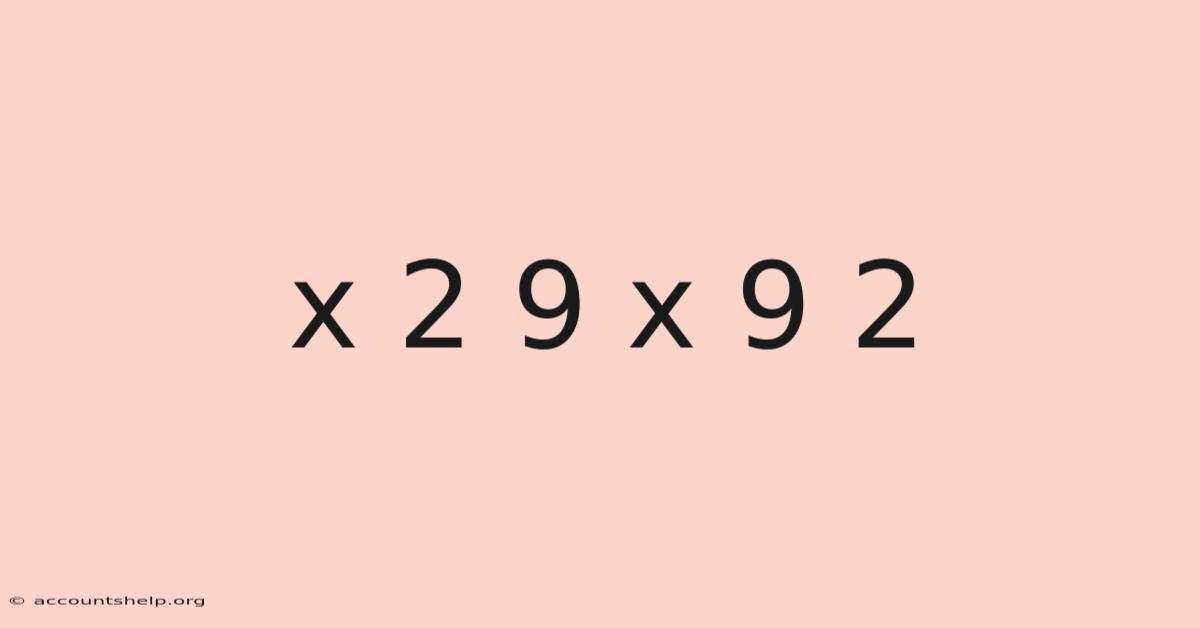
x 2 9 x 9 2
Let’s start with something that probably looks like a typo but isn’t. You’ve seen it in algebra class, maybe scribbled in the margin of a notebook, or typed into a calculator with a shrug. x 2 9 x 9 2 — what even is this?
At first glance, it might look like a random string of numbers and letters. It’s not just symbols on a page. But if you’ve spent any time working through quadratic equations, you’ll recognize this as a specific kind of algebraic expression. It’s a puzzle waiting to be solved.
So what does it actually mean? And why should you care?
What x 2 9 x 9 2 Actually Is
In plain terms, x 2 9 x 9 2 is a quadratic expression. Let’s clean it up so it makes sense:
$ x^2 - 9x + 9 $
Wait — where did the minus sign come from? Good question. The original phrasing “x 2 9 x 9 2” is a bit ambiguous, but in most math contexts, especially when dealing with quadratics, it usually refers to something like:
$ x^2 - 9x + 9 $
Or possibly:
$ x^2 + 9x + 9 $
But let’s go with the first version for now — $ x^2 - 9x + 9 $. Still, why? Because it leads to more interesting territory.
This is a standard form quadratic equation:
$ ax^2 + bx + c $
Where:
- $ a = 1 $
- $ b = -9 $
- $ c = 9 $
That means we’re looking at a parabola that opens upward (since $ a > 0 $), and we can analyze its roots, vertex, discriminant, and graph using well-known methods.
Why This Expression Matters
You might be thinking: “Okay, cool, it’s just another quadratic. Why write a whole article about it?”
Fair point. But here’s the thing — this particular expression shows up in problems involving optimization, factoring challenges, and even some real-world applications where relationships follow a squared pattern.
More importantly, understanding how to work with expressions like $ x^2 - 9x + 9 $ builds foundational skills used everywhere in higher-level math. Whether you're solving for unknowns, graphing functions, or prepping for standardized tests, this kind of problem is a building block.
And honestly? There's something satisfying about recognizing patterns in seemingly messy expressions. Once you see how these pieces fit together, algebra starts feeling less like memorization and more like puzzle-solving.
How to Work With x 2 9 x 9 2
Let’s roll up our sleeves and dig into how to handle this expression step by step.
### Finding the Roots Using the Quadratic Formula
One of the most reliable ways to solve any quadratic equation is the quadratic formula:
$ x = \frac{-b \pm \sqrt{b^2 - 4ac}}{2a} $
For our expression $ x^2 - 9x + 9 $, plugging in the values gives us:
$ x = \frac{-(-9) \pm \sqrt{(-9)^2 - 4(1)(9)}}{2(1)} $
$ x = \frac{9 \pm \sqrt{81 - 36}}{2} $
$ x = \frac{9 \pm \sqrt{45}}{2} $
Now simplify $ \sqrt{45} $. Since $ 45 = 9 \times 5 $, we get:
$ \sqrt{45} = 3\sqrt{5} $
So the final answer becomes:
$ x = \frac{9 \pm 3\sqrt{5}}{2} $
Which means the two solutions are:
$ x = \frac{9 + 3\sqrt{5}}{2}, \quad x = \frac{9 - 3\sqrt{5}}{2} $
These aren’t clean integers — they involve irrational numbers. That tells us the graph of this function won’t cross the x-axis at nice whole-number points. Also, which is totally fine. Not every quadratic factors neatly.
### Checking the Discriminant
Before jumping into calculations, it helps to check the discriminant — that part under the square root:
$ \Delta = b^2 - 4ac = (-9)^2 - 4(1)(9) = 81 - 36 = 45 $
Since the discriminant is positive but not a perfect square, we know there are two distinct real roots, both irrational. No repeated roots, no complex numbers — just messy decimals.
### Completing the Square (Alternative Method)
Another way to approach this is completing the square. Start with:
$ x^2 - 9x + 9 = 0 $
Move the constant term to the other side:
$ x^2 - 9x = -9 $
To complete the square, take half of the coefficient of $ x $, then square it:
$ \left(\frac{-9}{2}\right)^2 = \frac{81}{4} $
Add that to both sides:
$ x^2 - 9x + \frac{81}{4} = -9 + \frac{81}{4} $
Continue exploring with our guides on what are the two components of the renal corpuscle and properties of parallelograms worksheet answers pdf.
$ \left(x - \frac{9}{2}\right)^2 = \frac{-36 + 81}{4} = \frac{45}{4} $
Take the square root of both sides:
$ x - \frac{9}{2} = \pm \sqrt{\frac{45}{4}} = \pm \frac{3\sqrt{5}}{2} $
Solve for $ x $:
$ x = \frac{9}{2} \pm \frac{3\sqrt{5}}{2} $
Same result as before. Nice consistency.
### Graphing the Parabola
If you want to visualize this function, the vertex form is helpful. From the completed square above:
$ f(x) = \left(x - \frac{9}{2}\right)^2 - \frac{45}{4} + 9 $
Simplify the constants:
$ -\frac{45}{4} + 9 = -\frac{45}{4} + \frac{36}{4} = -\frac{9}{4} $
So the vertex form is:
$ f(x) = \left(x - \frac{9}{2}\right)^2 - \frac{9}{4} $
This tells us the vertex is at $ \left(\frac{9}{2}, -\frac{9}{4}\right) $, or approximately $ (4.The axis of symmetry is $ x = 4.5, -2.25) $. 5 $, and since $ a > 0 $, the parabola opens upward.
Common Mistakes People Make
Even experienced students trip over certain pitfalls when working with expressions like this. Here are a few worth watching out for.
### Misreading the Signs
The biggest mistake? If someone reads “x 2 9 x 9 2” quickly, they might assume all signs are positive. Confusing whether the middle term is positive or negative. But depending on context, it could easily be $ x^2 - 9x + 9 $. Always double-check the signs before diving into calculations.
### Forgetting to Simplify Radicals
After applying the quadratic formula, many people stop too early. They leave answers like $ \sqrt{45} $ instead of simplifying to $ 3\sqrt{5} $. While technically correct, simplified radicals are easier to work with and often required in formal settings.
### Assuming It Factors Nicely
Some students try to factor $ x^2 - 9x + 9 $ by guessing pairs of numbers that multiply to 9 and add to -9. Spoiler alert: there are no such integer pairs. When factoring doesn’t work cleanly, switch to the quadratic formula or completing the square.
### Mixing Up Numerators and Denominators
When using the quadratic formula, it’s easy to mess
### Mixing Up Numerators and Denominators
When you write the quadratic formula, the entire numerator sits over a common denominator of (2a). And it’s tempting to separately divide the (b) term and the square‑root term, then combine them later. That shortcut can lead to a misplaced sign or an extra factor of two. The safest route is to keep the fraction intact until you’ve simplified the expression inside the square root, then perform the division all at once.
Other Common Pitfalls
| Pitfall | Why it Happens | Quick Fix |
|---|---|---|
| Assuming the discriminant is always a perfect square | We’re used to nice, tidy numbers. When (b^2-4ac) isn’t a perfect square, the roots are irrational, and many students simply write “no real solutions.” | Perform the square‑root operation; the result will be an irrational number, e.Because of that, g. (\frac{9\pm3\sqrt{5}}{2}). Now, |
| Treating the quadratic as a linear equation | Some novices drop the (x^2) term and solve ( -9x + 9 = 0) by mistake. Which means | Double‑check that you’re working with the full quadratic expression before applying any formula. |
| Using the wrong sign for the “(+)” or “(-)” in the formula | The formula has two solutions, one with a plus and one with a minus. Swapping them or forgetting one yields a single, incorrect root. Here's the thing — | Write both possibilities explicitly: (\frac{-b \pm \sqrt{b^2-4ac}}{2a}). |
| Neglecting to simplify the vertex form | After completing the square, many leave the expression in a messy form. | Combine constants and factor out any common factors before drawing conclusions about the vertex. Now, |
| Assuming the axis of symmetry is always (x = a) | The axis is actually (x = -\frac{b}{2a}). Practically speaking, for (x^2-9x+9), it’s (x=\frac{9}{2}). | Use the formula (x = -\frac{b}{2a}) to avoid mistakes. |
Quick Recap of the Solution Path
- Identify coefficients: (a = 1), (b = -9), (c = 9).
- Compute the discriminant: (\Delta = (-9)^2 - 4(1)(9) = 45).
- Apply the quadratic formula:
[ x = \frac{-(-9) \pm \sqrt{45}}{2(1)} = \frac{9 \pm 3\sqrt{5}}{2}. ] - Complete the square (optional):
[ x = \frac{9}{2} \pm \frac{3\sqrt{5}}{2}. ] - Graph the parabola: Vertex at (\left(\frac{9}{2}, -\frac{9}{4}\right)), opens upward, real intercepts at the two roots.
Final Thoughts
Solving (x^2 - 9x + 9 = 0) is a textbook illustration of the power of algebraic tools. The quadratic formula offers a universal shortcut, while completing the square reveals the geometric story of the parabola’s vertex. By watching for the common missteps—misreading signs, mishandling fractions, or assuming integer factors—you’ll keep your solutions clean and accurate.
It's worth noting — this step matters more than it seems.
Whether you’re a student tackling homework or a teacher preparing a lesson, remember that the elegance of quadratic equations lies not just in the final(x) numbers, but in the systematic approach that turns a seemingly messy expression into a clear, exact answer.
Latest Posts
Out This Morning
-
Are Protons And Neutrons Smaller Than Electrons
Aug 07, 2026
-
Three Coplanar Lines That Intersect In Three Different Points
Aug 07, 2026
-
X 2 9 X 9 2
Aug 07, 2026
-
Which Element Requires The Most Energy To Lose One Electron
Aug 07, 2026
-
Which Of The Following Are Similarities Between Mitochondria And Chloroplasts
Aug 07, 2026
Related Posts
What Others Read After This
-
Which Is A Non Membrane Bound Organelle
Aug 01, 2026
-
How To Solve For Limiting Reagent
Aug 01, 2026
-
How Many Electrons In The F Orbital
Aug 01, 2026
-
Length Of Segment Of Circle Formula
Aug 01, 2026
-
What Type Of Tissue Is Avascular
Aug 01, 2026
