Y 4 X 2 Z 2
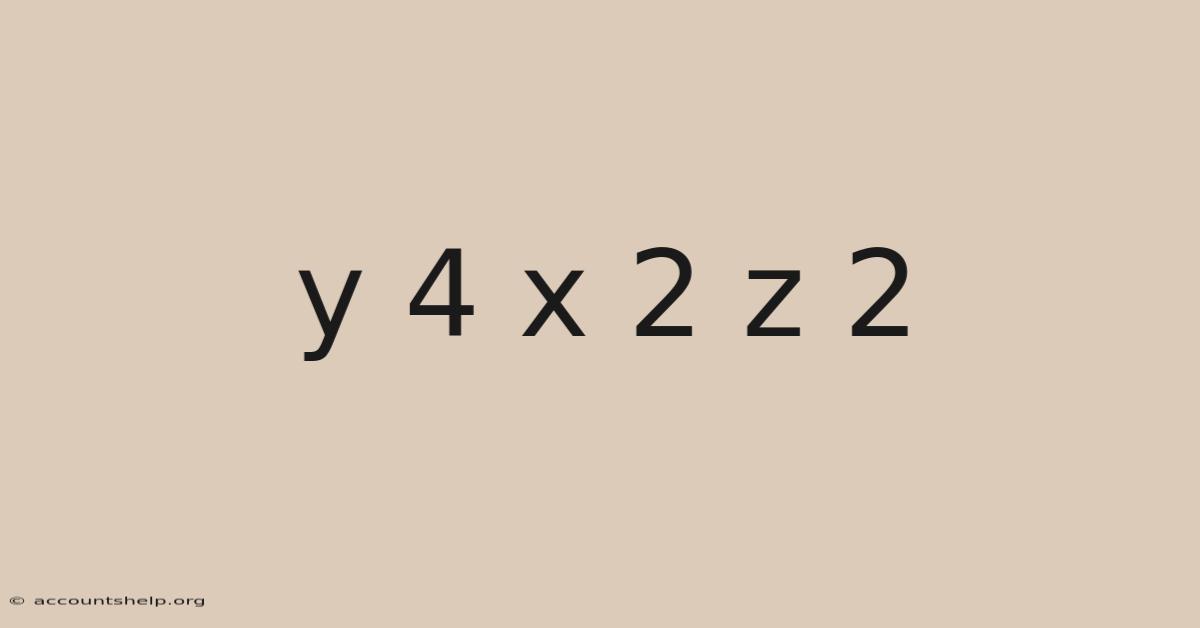
You're staring at a string of letters and numbers — y⁴ x² z² — and your brain does that little freeze thing. Maybe you're helping a kid with homework and the textbook explanation reads like it was written by a robot for robots. Maybe it's been twenty years since algebra class. Maybe you're coding a physics engine and need to remember how exponents behave when variables multiply.
Whatever brought you here, let's clear the fog. It's just notation. This isn't a trick. And once you see the pattern, you'll wonder why it ever looked intimidating.
What Is y⁴ x² z²
At its core, this is a monomial — a single algebraic term made of a coefficient (the number in front, which is 1 here, invisible) and variables raised to powers. Now, no minus signs. In practice, no plus signs. Just multiplication.
- y⁴ means y × y × y × y
- x² means x × x
- z² means z × z
Put them together and you're multiplying seven factors total: four y's, two x's, two z's. The order doesn't matter — multiplication commutes. You could write it x² y⁴ z² or z² x² y⁴ and it's the exact same mathematical object.
The invisible coefficient
Here's something textbooks skip: every term has a coefficient. That said, it's not written because 1 times anything is itself. But when you start combining like terms or distributing, that invisible 1 matters. In y⁴ x² z², the coefficient is 1. Forget it exists and you'll drop coefficients constantly.
Variables vs. constants
x, y, z are variables — placeholders for numbers we might not know yet. So naturally, this distinction trips people up when they start differentiating or integrating later. They tell you how many times* to use each variable as a factor. The exponent is not a variable. Day to day, the exponents (4, 2, 2) are constants. It's a fixed instruction.
Why It Matters
You see monomials like this everywhere. Also, polynomial long division. Factoring quadratics. Calculus derivatives. Physics formulas for kinetic energy, gravitational force, electrical resistance. The moment you stop recognizing y⁴ x² z² as "just multiplication written compactly," every downstream topic gets harder.
The exponent rules live here
All the exponent laws — product rule, power rule, quotient rule, zero exponent, negative exponents — are just shortcuts for counting factors. If you can expand y⁴ x² z² into y·y·y·y·x·x·z·z and back again without thinking, you understand* the rules. You don't need to memorize them.
Real-world scaling
Say you're modeling how the volume of a rectangular box changes when you scale its dimensions. The exponent 8 on k isn't magic — it's 2+4+2. That's not a coincidence. Volume is x·y·z. Now you're dealing with (kx)²(ky)⁴(kz)² = k⁸ x² y⁴ z². Here's the thing — length scales with x, width with y, height with z. Scale each dimension by a factor? That's why the sum of the original exponents. It's the product rule in action.
How It Works
Let's break down the operations you'll actually do with a term like this.
Multiplying by another monomial
Suppose you need (y⁴ x² z²) · (y³ x z⁵).
Don't reach for a mnemonic. Just count factors.
- y: four from the first, three from the second → y⁷
- x: two from the first, one from the second → x³
- z: two from the first, five from the second → z⁷
Result: y⁷ x³ z⁷ (or x³ y⁷ z⁷ — alphabetical order is convention, not law).
The product rule — add exponents when bases match — is exactly this counting process.
Dividing by another monomial
Now try (y⁴ x² z²) ÷ (y x z³).
Write it as a fraction if it helps:
y⁴ x² z²
────────
y¹ x¹ z³
Cancel matching factors. Four y's on top, one on bottom → three y's left on top. Two x's on top, one on bottom → one x left. Two z's on top, three on bottom → one z left on bottom*.
Result: y³ x / z or x y³ z⁻¹ if you prefer negative exponents.
The quotient rule — subtract exponents — is just cancellation with less writing.
Raising to a power
What about (y⁴ x² z²)³?
This means multiply the term by itself three times:
(y⁴ x² z²) · (y⁴ x² z²) · (y⁴ x² z²)
Count factors: y gets 4+4+4 = 12. x gets 2+2+2 = 6. z gets 2+2+2 = 6.
Result: y¹² x⁶ z⁶.
The power rule — multiply exponents — is repeated addition. 3 × 4 = 12.In practice, 3 × 2 = 6. That's it.
Substituting values
This is where the rubber meets the road. If x = 2, y = 3, z = 5, what's y⁴ x² z²?
For more on this topic, read our article on what are the two types of agglutinogens or check out how can you prove a triangle is isosceles.
Don't plug into the compact form. Expand mentally:
3⁴ × 2² × 5² = 81 × 4 × 25
81 × 4 = 324.324 × 25 = 8100.
Or group differently: (3² × 5)² × 2² = (9 × 5)² × 4 = 45² × 4 = 2025 × 4 = 8100.
Same answer. Which means the second way is faster if you spot the squares. This is why factoring and regrouping matter — they turn arithmetic into mental math.
Common Mistakes
Adding exponents across different bases
The #1 error: seeing y⁴ x² and writing y⁶ or x⁶ or (yx)⁶. This mistake persists into calculus where students try to combine d/dx(x²y³) into something like (xy)⁵. Which means ever. ** y and x are different variables. You cannot add their exponents. **Bases must match to combine exponents.It's wrong every time.
Distributing exponents over addition
(y⁴ x² z²)² ≠ y⁸ + x⁴ + z⁴.
Exponents distribute over multiplication*, not addition. The latter expands to a²+b²+c²+2ab+2ac+2bc. But (a+b+c)² ≠ a²+b²+c². (abc)² = a²b²c². This confusion causes endless grief in algebra and calculus.
Forgetting the coefficient
3y⁴ x² z² squared is 9 y⁸ x⁴ z⁴, not 3 y⁸ x⁴ z⁴. The coefficient gets squared too. Every factor inside the parentheses gets the outer exponent. The invisible 1 becomes 1² = 1 (harmless).
Every factor inside the parentheses gets the outer exponent. And the invisible 1 becomes 1² = 1 (harmless). A visible 3 becomes 9 (easy to miss when you’re focused on the variables).
So ((3y^{4}x^{2}z^{2})^{2}=3^{2}y^{8}x^{4}z^{4}=9y^{8}x^{4}z^{4}). The same rule applies no matter how many terms sit inside the brackets: every coefficient, every variable, every hidden factor is raised to the outer power.
When the exponent is a fraction
Sometimes you’ll see a rational exponent, e.Also, g. Still, ((y^{4}x^{2}z^{2})^{\frac12}). Think of “raising to a half‑power” as taking a square root of the whole expression.
[ (y^{4}x^{2}z^{2})^{\frac12}=y^{4\cdot\frac12}x^{2\cdot\frac12}z^{2\cdot\frac12}=y^{2}x^{1}z^{1}=y^{2}xz. ]
If the denominator of the fraction is even, you must assume the base is non‑negative (or work in the complex numbers) to keep the root real. The same idea extends to cube roots, fourth roots, and so on—just multiply the inner exponent by the fraction.
Negative exponents in disguise
A negative exponent on a whole product works the same way:
[ (y^{4}x^{2}z^{2})^{-1}=y^{-4}x^{-2}z^{-2}=\frac{1}{y^{4}x^{2}z^{2}}. ]
If the negative exponent appears on a coefficient, the same rule holds:
[ (5y^{4}x^{2}z^{2})^{-2}=5^{-2}y^{-8}x^{-4}z^{-4}=\frac{1}{25y^{8}x^{4}z^{4}}. ]
It’s often easier to flip the fraction first and then apply the positive exponent, especially when you’re simplifying a quotient of powers.
A quick checklist for expanding powers of products
- Identify the outer exponent. Is it an integer, a fraction, or a negative number?
- Apply it to every factor inside the parentheses—coefficients, variables, even the implicit 1.3. Multiply the inner exponent by the outer one for each variable.
- Simplify the coefficient (e.g., (3^{2}=9), ((-2)^{3}=-8)).
- Rewrite with only positive exponents if the final answer is meant to be a conventional expression (move negative exponents to the denominator).
- Combine like terms if any variables share the same base after the distribution (this usually happens after a quotient or a product of similar terms).
Why mastering this matters
When you can expand powers of products fluently, you gain two crucial abilities:
- Speed in algebraic manipulation. Many later topics—factoring polynomials, simplifying rational expressions, solving exponential equations—rely on quickly rewriting powers.
- Insight into the structure of functions. In calculus, the chain rule treats a composite function like ((g(x))^{n}) as (n(g(x))^{n-1}g'(x)). Recognizing that the outer exponent applies to the entire inner expression is exactly what you practiced here.
Conclusion
The power of a product rule may appear at first glance to be a mechanical shortcut, but it is grounded in the same counting principles you used when first learning to multiply monomials. By expanding deliberately, counting matching bases, and remembering that every factor—coefficient or variable—carries the outer exponent, you turn what could be a source of error into a reliable tool. Avoid the common pitfalls of mixing bases, distributing over addition, or ignoring coefficients, and you’ll find that even the most intimidating algebraic expressions become manageable. Master this foundation, and the doors to more advanced topics in algebra, calculus, and beyond swing wide open.
Latest Posts
Related Posts
Before You Go
-
Which Is A Non Membrane Bound Organelle
Aug 01, 2026
-
How To Solve For Limiting Reagent
Aug 01, 2026
-
How Many Electrons In The F Orbital
Aug 01, 2026
-
Length Of Segment Of Circle Formula
Aug 01, 2026
-
What Type Of Tissue Is Avascular
Aug 01, 2026
