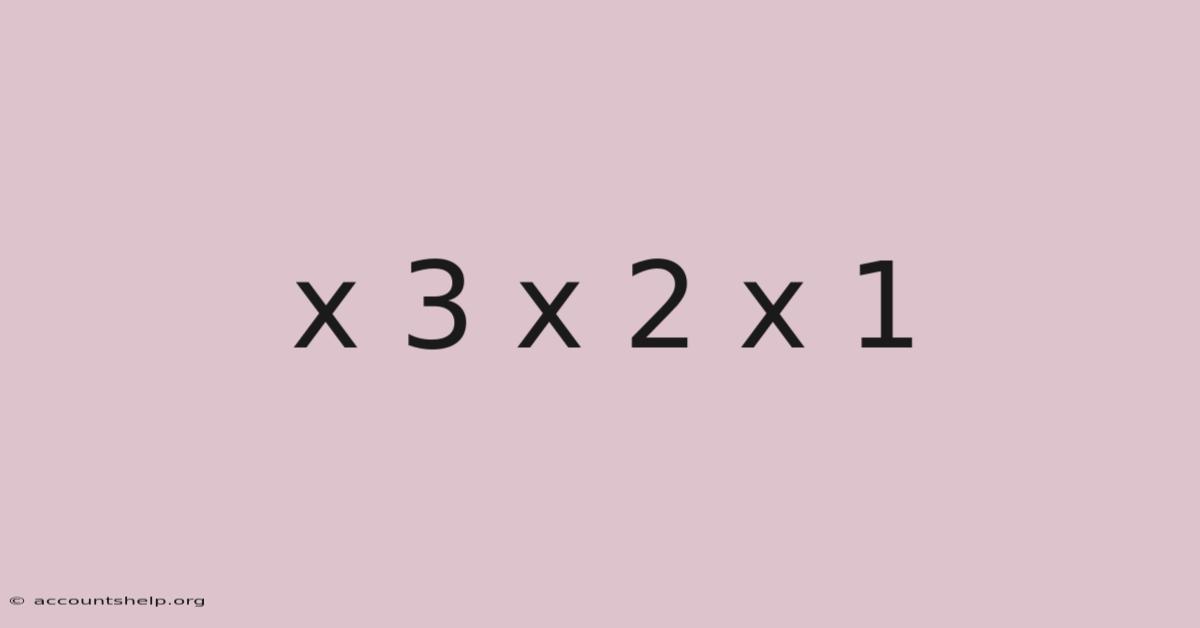
Why You Should Care About x 3 x 2 x 1
Most people see this and think it's just another math problem. But hold on—x 3 x 2 x 1 is actually factorial notation in disguise. That said, it's 3! written out fully. And that tiny bit of notation opens a door to some surprisingly powerful ideas in mathematics, computer science, and even how we think about problems.
So what's really going on when you multiply 3 times 2 times 1?
What Is x 3 x 2 x 1
At its core, x 3 x 2 x 1 is the expanded form of 3 factorial, written as 3!. The factorial function takes a positive integer and multiplies it by every positive integer smaller than it, all the way down to 1.
So when we write: 3 x 2 x 1 = 6
We're calculating how many ways we can arrange three distinct items. Plus, think of it like this: if you have three books and want to know how many different orders you can place them on a shelf, the answer is 3! = 6 Simple, but easy to overlook..
The sequence matters here. Placing books A, B, C in the order ABC is different from BAC, even though both use the same three books.
The Mathematical Pattern
Factorials grow fast. Here's how it works:
- 1! = 1
- 2! = 2 x 1 = 2
- 3! = 3 x 2 x 1 = 6
- 4! = 4 x 3 x 2 x 1 = 24
- 5! = 5 x 4 x 3 x 2 x 1 = 120
Each step multiplies by the next integer. , you're already at 3,628,800. By the time you reach 10!That's over three and a half million arrangements of just ten things Still holds up..
Why Not Start with Zero?
You might wonder why factorials start at 1 instead of 0. But here's the thing: 0! Also, after all, 0 seems like a natural starting point. equals 1 by definition. This isn't arbitrary—it's a convention that makes the mathematical rules work consistently.
Think of it this way: there's exactly one way to arrange zero objects—do nothing. So 0! = 1 keeps the pattern consistent when you're working with formulas that need to handle edge cases smoothly Most people skip this — try not to..
Why People Care About This Pattern
Factorials aren't just mathematical curiosities. They show up everywhere once you know where to look.
Counting Arrangements
The most straightforward application is counting permutations—different arrangements of the same set. If you're planning a trip with 4 cities to visit, there are 4! On top of that, = 24 possible routes. If you're setting a password with 3 distinct characters, and each character can only be used once, there are 3! = 6 possible combinations The details matter here..
Quick note before moving on Easy to understand, harder to ignore..
Probability and Statistics
Factorials appear constantly in probability calculations. When you're figuring out the odds of drawing certain cards, arranging people in lines, or distributing items among groups, factorials help you count the total possibilities But it adds up..
Computer Science and Algorithms
In programming, factorials help analyze algorithm complexity. When a program needs to check every possible arrangement of data—like solving a puzzle or optimizing routes—the time it takes grows factorially. That's why some problems are notoriously slow to solve with brute force approaches Simple, but easy to overlook..
How Factorials Actually Work
Let's dig into the mechanics a bit more deeply Simple, but easy to overlook..
The Recursive Relationship
Factorials have a neat recursive property: n! = n x (n-1)!
So 5! = 5 x 4! Which means this relationship is what makes factorials so useful in mathematical proofs and programming. = 5 x 24 = 120. You can define a factorial function that calls itself with a smaller input until it reaches the base case of 1!.
Real-World Example: Shuffling Cards
Take a standard deck of 52 cards. The number of possible arrangements is 52!Also, that's roughly 8 x 10^67 possible decks. Day to day, —a number so large it's hard to comprehend. Even if every person on Earth shuffled a deck every second for the entire history of the universe, we still wouldn't come close to exhausting the possibilities.
This is why card games rely on chance. The odds of anyone ever seeing the same shuffled deck twice are effectively zero That's the part that actually makes a difference. Took long enough..
Approximation: Stirling's Formula
For large values of n, calculating n! exactly becomes cumbersome. Mathematicians use Stirling's approximation:
n! ≈ √(2πn) x (n/e)^n
This gives you a good estimate without multiplying out all the terms. It's incredibly useful in statistics and physics when dealing with large numbers.
Common Mistakes People Make
Even experienced folks slip up on factorial calculations sometimes.
Order of Operations Confusion
One classic mistake is misunderstanding what x 3 x 2 x 1 represents. Some people try to solve it as if the x's are variables to be solved for, rather than multiplication symbols. Remember: x here means multiply, not an unknown quantity.
People argue about this. Here's where I land on it.
Forgetting the Base Case
When programming factorial functions, beginners often forget to handle the base case. Always remember: 0! Still, = 1 and 1! Think about it: writing a function that calls itself recursively without a stopping condition leads to infinite loops or stack overflow errors. = 1 No workaround needed..
Misapplying to Non-Integer Values
Factorials are defined only for non-negative integers. Practically speaking, you can't calculate 2. Which means 5! or (-1)! in the standard sense. Though mathematicians have extended the concept using the gamma function for complex numbers, that's beyond basic factorial calculations Simple as that..
Overlooking Practical Limits
In computing, factorials quickly exceed the maximum values that standard data types can handle. A 32-bit integer can only hold values up to about 2.Also, 1 billion, but 12! = 479,001,600 and 13! already exceeds that limit. This is why programmers need to be careful about integer overflow when working with factorials.
What Actually Works in Practice
Here are some practical approaches that work well.
Mental Math Shortcuts
For small factorials, it helps to memorize the first few:
- 1! = 1
- 2! = 2
- 3! = 6
- 4! = 24
- 5! = 120
These come up often enough that having them at your fingertips saves time. Plus, for 6! and beyond, you can build up from known values: 6! = 6 x 5! = 720 The details matter here..
Using Logarithmic Calculations
When dealing with large factorials, direct calculation can cause overflow. Here's the thing — instead, you can work with logarithms: log(n! ) = log(n) + log((n-1)!On top of that, ) + ... Even so, + log(1). This approach avoids intermediate overflow and lets you compare factorials without computing their full values.
Programming Considerations
In code, use appropriate data types. Languages like Python handle arbitrary-precision integers automatically, so you can calculate large factorials directly. In languages like C or Java, you'll need to use specialized libraries or switch to floating-point types (though this introduces rounding errors) Not complicated — just consistent..
Not obvious, but once you see it — you'll see it everywhere.
Approximation for Estimation
When you need to know which of two factorials is larger, or roughly how big a factorial might be, Stirling's approximation works well. It's especially useful in probability calculations where you're taking ratios of factorials.
Frequently Asked Questions
What does "x 3 x 2 x 1" mean? It's the expanded form of 3 factorial, or 3!. It represents the product of all positive integers from 3 down to 1 Small thing, real impact..
Why is 0! equal to 1? This convention ensures mathematical consistency. There's exactly one way to arrange zero objects—do nothing. It also makes formulas like n! = n x (n-1)! work correctly when n = 1.
Can factorials be negative? No, factorials are only defined for non-negative integers. Negative numbers don't have factorials in the standard sense Nothing fancy..
Are there practical applications of factorials? Absolutely. They're essential in probability, combinatorics, statistics, computer science, and anywhere you need to count arrangements or permutations Most people skip this — try not to..
How do I calculate large factorials? Direct calculation quickly becomes impractical. Use approximation methods like Stirling
s approximation, logarithmic calculations, or arbitrary-precision libraries in programming. Here's one way to look at it: in Python, you can compute 100! directly, while in C++, you’d need a library like GMP. What’s the largest factorial I can compute? It depends on your tools. In Python, there’s no hard limit—only your computer’s memory matters. In Excel, the limit is much smaller due to cell size constraints.
Conclusion
Factorials are a cornerstone of mathematics, bridging abstract theory and real-world applications. From calculating permutations to modeling probabilities, they reveal the complexity hidden in simple arrangements. While computational limits and approximations are necessary for large values, understanding their foundational principles ensures accurate problem-solving. Whether you’re a student memorizing early factorials, a programmer handling overflows, or a statistician estimating odds, mastering factorials equips you to tackle challenges across disciplines. Remember: even though 13! exceeds 32-bit integers, the beauty of factorials lies not just in their size, but in their universal role as a tool for counting the infinite possibilities of order.
