X 3 6x 2 11x 6
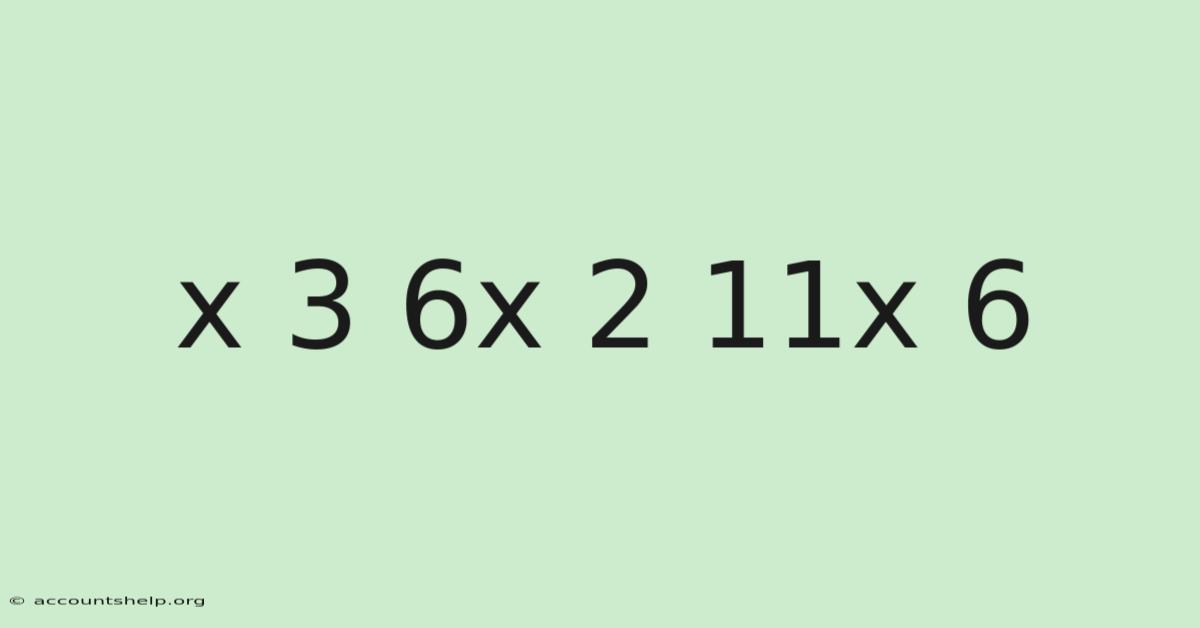
The Polynomial That Won't Factor Nicely
You've probably seen it before — a polynomial that looks like it should factor cleanly, but every attempt leaves you staring at a mess of numbers. Maybe you're working through a textbook problem set, or perhaps you're helping someone with algebra homework, and suddenly you hit a wall. Practically speaking, that's exactly where x³ - 6x² + 11x - 6* tends to show up. It's not the most complicated cubic, but it has a way of tripping people up because it doesn't announce its factors the way simpler polynomials do.
Let's break this down.
What Is x³ - 6x² + 11x - 6?
Basically a cubic polynomial — a third-degree equation in standard form. In plain terms, it's an expression with three terms involving powers of x, arranged from highest to lowest degree:
x³ - 6x² + 11x - 6*
The goal when working with polynomials like this one is usually to factor them — to rewrite them as a product of simpler expressions. That's why for example, a quadratic like x² - 5x + 6* factors into (x - 2)(x - 3). But cubics are trickier. You can't just guess and check the same way.
So what makes this particular polynomial stand out? Well, it turns out that despite looking resistant to factoring at first glance, it actually breaks apart quite neatly — if you know how to look.
Why It Matters / Why People Care
Understanding how to factor polynomials like x³ - 6x² + 11x - 6* matters because factoring is one of those foundational skills that keeps showing up. Whether you're solving equations in calculus, simplifying rational expressions, or analyzing functions in engineering, being able to decompose a polynomial into its factors gives you power over the problem.
More than that, this specific polynomial serves as a great teaching example. It demonstrates several important techniques:
- Rational Root Theorem: A method for guessing possible roots based on coefficients.
- Synthetic division: A streamlined way to divide polynomials once you suspect a root.
- Pattern recognition: Learning to see structure beneath the surface.
And here's the thing — many students encounter this polynomial in class and immediately try to apply quadratic-style factoring. Consider this: that's where frustration sets in. And you can't treat a cubic like a quadratic. But once you learn the right approach, it becomes manageable.
How It Works (or How to Factor It)
Let's walk through the process step by step.
Step 1: Look for Rational Roots Using the Rational Root Theorem
Let's talk about the Rational Root Theorem says that any rational solution (or root) of a polynomial with integer coefficients must be a fraction p/q, where p divides the constant term and q divides the leading coefficient.
In our case:
- Constant term = -6 → factors: ±1, ±2, ±3, ±6
- Leading coefficient = 1 → factors: ±1
So the only possible rational roots are: ±1, ±2, ±3, ±6
That narrows things down significantly.
Step 2: Test Possible Roots by Substitution
Now plug each candidate value into the polynomial until you find one that equals zero.
Try x = 1*: (1)³ - 6(1)² + 11(1) - 6 = 1 - 6 + 11 - 6 = 0
Boom. We found a root.
Step 3: Use Synthetic Division to Factor Out (x - 1)
Since x = 1* is a root, we know (x - 1) is a factor. Now use synthetic division to divide the original polynomial by (x - 1):
1 |  1   -6    11   -6
   |       1    -5    6
   -------------------
     1   -5     6    0
This gives us a quotient of x² - 5x + 6*.
Step 4: Factor the Quadratic
Now factor x² - 5x + 6*:
We need two numbers that multiply to 6 and add to -5. Those numbers are -2 and -3.
So: x² - 5x + 6 = (x - 2)(x - 3)*
Final Answer
Putting it all together:
x³ - 6x² + 11x - 6 = (x - 1)(x - 2)(x - 3)*
For more on this topic, read our article on which pair of atoms are isotopes or check out find the area bounded by the curve.
Clean, right?
Common Mistakes / What Most People Get Wrong
Here are the errors I see most often when people tackle this kind of problem:
Assuming It Doesn’t Factor
Some students look at x³ - 6x² + 11x - 6* and assume it’s prime — impossible to factor. But that’s rarely true for textbook problems. Give the Rational Root Theorem a shot before giving up.
Skipping the Rational Root Theorem
Trying random values without strategy wastes time. Also, the Rational Root Theorem isn’t just busywork — it focuses your search. Use it.
Forgetting to Check All Candidates
Finding that x = 1* works feels good, but don’t stop there. Keep testing other candidates. Sometimes multiple roots exist, and missing them means incomplete factoring.
Misapplying Quadratic Techniques
You can’t factor a cubic using the same methods you’d use for a quadratic. Trying to group terms or guess binomial products usually leads nowhere fast.
Practical Tips / What Actually Works
Here’s what helps when working with polynomials like this:
Start Small
Always begin with small integers like ±1, ±2. They’re quick to test and often turn out to be roots.
Write Down Your Work
Especially during synthetic division, writing out each step prevents arithmetic mistakes. One wrong sign can derail everything.
Double-Check Your Factors
Once you think you’ve factored completely, multiply the factors back together. If you get the original polynomial, you did it right.
Practice Pattern Recognition
Over time, you’ll start recognizing common structures. This polynomial, for instance, has roots at consecutive integers — a pattern that appears in various forms.
Don’t Panic Over Signs
Negative coefficients can make substitution confusing. Slow down and handle signs carefully.
FAQ
Q: Can I factor x³ - 6x² + 11x - 6 without synthetic division?
A: Yes, though synthetic division is typically faster. You could use long division or even factor by grouping if you rearrange strategically, but synthetic division remains the most efficient route.
Q: What are the roots of this polynomial?
A: The roots are x = 1*, x = 2*, and x = 3*. These correspond directly to the factors (x - 1), (x - 2), and (x - 3).
Q: Is this polynomial used in real applications?
A: While this specific polynomial may not model a real-world scenario, the techniques used to factor it are essential in fields like physics, economics, and computer science where polynomial equations arise naturally.
Q: What if none of the rational candidates work?
A: Then the polynomial might not have rational roots. In such cases, you’d need numerical methods or the cubic formula, which are beyond basic algebra.
Q: How do I know when I’m done factoring?
A: When all remaining factors are either linear or irreducible quadratics (quadratics that can't be factored further), you’re finished.
Wrapping Up
Factoring x³ - 6x² + 11x - 6* isn’t about memorizing steps — it’s about developing a toolkit and knowing when to use each tool. The Rational Root Theorem points the way, synthetic division does the heavy lifting, and careful attention to detail ensures accuracy.
What makes this exercise valuable isn’t just the answer — it’s the process. Every time you work through a challenging polynomial, you’re training your eye to spot patterns, your mind to stay organized under pressure, and your confidence to trust the math.
So next time you see a cubic that seems impossible, remember: it’s probably not as hard as it looks. Just take it one step at a time.
Latest Posts
Out the Door
-
Which Reaction Represents The Disproportionation Of Hydrogen Peroxide
Aug 15, 2026
-
How To Find Out The Surface Area Of A Cuboid
Aug 15, 2026
-
Isotopes Of An Element Have A Different Number Of
Aug 15, 2026
-
What Do Plant Cells Have That Animal Cells Dont
Aug 15, 2026
-
Which Of The Following Reactions Will Occur
Aug 15, 2026
Related Posts
A Few More for You
-
Which Is A Non Membrane Bound Organelle
Aug 01, 2026
-
How To Solve For Limiting Reagent
Aug 01, 2026
-
How Many Electrons In The F Orbital
Aug 01, 2026
-
Length Of Segment Of Circle Formula
Aug 01, 2026
-
What Type Of Tissue Is Avascular
Aug 01, 2026
