X 3 4x 2 4x 16
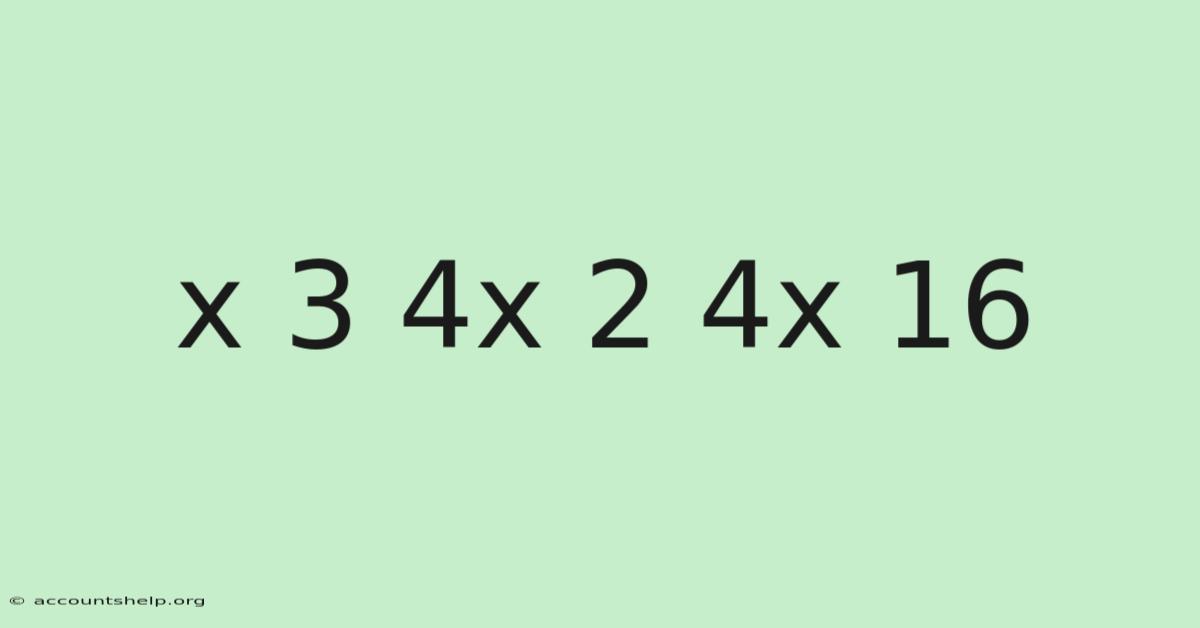
x 3 4x 2 4x 16: The Hidden Power Behind This Simple Math Trick
Let’s start with a question: Have you ever seen a math problem that looks like gibberish but somehow makes perfect sense once you break it down? That’s exactly what x 3 4x 2 4x 16 looks like at first glance. In real terms, it’s a jumble of letters and numbers that seems random—until you realize it’s a clever way to express relationships between variables. Even so, this isn’t just a math exercise; it’s a gateway to understanding how algebra simplifies complex ideas. Whether you’re a student struggling with equations or a curious mind looking for patterns, this trick might just change how you see math.
Here’s the thing: x 3 4x 2 4x 16 isn’t a standalone concept. It’s a shorthand for something bigger. The goal? Think of it as a puzzle where each part—x 3, 4x 2, 4x 16—represents a piece of a larger equation. To decode how these pieces fit together. Because once you grasp the logic behind it, you’ll start spotting similar patterns everywhere, from physics problems to financial models. Why does this matter? Let’s dive in.
What Is x 3 4x 2 4x 16?
At its core, x 3 4x 2 4x 16 is a way to describe how a variable (like x) interacts with different coefficients. Let’s unpack each part:
x 3: The Baseline
The first term, x 3, is straightforward. It means x multiplied by 3, or 3x. This is your starting point. Imagine x as a number you don’t know yet. Multiplying it by 3 gives you a value that’s three times whatever x is. Simple, right?
4x 2: Doubling the Fun
Next up is 4x 2. This translates to 4 times x squared (4x²). Here, x isn’t just multiplied by 4—it’s squared first. Squaring a number means multiplying it by itself (e.g., if x is 2, x² is 4). Then, you multiply that result by 4. This term grows faster than 3x because squaring amplifies the value of x.
4x 16: The Wildcard
Finally, 4x 16 means 4 times x to the 16th power (4x¹⁶). This is where things get intense. Raising x to the 16th power creates a massive number, especially if x is greater than 1. Take this: if x is 2, x¹⁶ is 65,536, and multiplying that by 4 gives 262,144. This term dominates the equation when x is large.
Putting it all together, x 3 4x 2 4x 16 isn’t a single equation but a collection of terms. Day to day, the challenge? So it’s like a recipe where each ingredient plays a role. Figuring out how these terms interact when combined.
Why Does This Matter?
You might be thinking, “Why should I care about x 3 4x 2 4x 16?Here’s the deal: This isn’t just abstract math. ” Fair question. It’s a tool for solving real-world problems.
1. Modeling Growth
Imagine you’re tracking the growth of a plant. If x represents time in days, 3x could model linear growth (e.g., 3 inches per day), while 4x² might represent exponential growth (e.g., the plant doubles in size every day). The 4x¹⁶ term? That’s for scenarios where growth becomes astronomical*—like a viral social media post or a compounding investment.
2. Physics and Engineering
In physics, equations like this describe motion, energy, or forces. Here's one way to look at it: 4x² could model the distance an object travels under acceleration, while 4x¹⁶ might represent a hypothetical scenario with extreme forces. Engineers use similar logic to design bridges, rockets, or even video game physics.
3. Finance and Economics
Financial models often use exponential terms to predict market trends. If x is the number of years, 4x¹⁶ could simulate the impact of compound interest over decades. The key takeaway? Small changes in x can lead to wildly different outcomes.
How Does x 3 4x 2 4x 16 Work?
Let’s get technical. To solve or simplify x 3 4x 2 4x 16, you need to follow algebraic rules. Here’s the step-by-step:
Step 1: Combine Like Terms
First, identify terms with the same exponent. In this case, x 3 (which is 3x) and 4x 2 (which is 4x²) are separate. The 4x 16 term stands alone because its exponent is unique.
Step 2: Apply Exponent Rules
If you’re multiplying terms with the same base, add the exponents. But here, each term has a different base or exponent, so you can’t combine them directly. To give you an idea, 3x and 4x² can’t be merged because their exponents differ.
Want to learn more? We recommend 3 examples of a chemical reaction and which of the following is a primary lymphatic organ for further reading.
Step 3: Simplify When Possible
If the equation is set to zero (e.g., 3x + 4x² + 4x¹⁶ = 0), you’d factor out common terms. But with x 3 4x 2 4x 16, there’s no equals sign, so simplification depends on context.
Step 4: Plug in Values
If you’re given a specific value for x, substitute it into each term. Here's a good example: if x = 2:
- 3x = 3(2) = 6
- 4x² = 4(2²) = 4(4) = 16
- 4x¹⁶ = 4(2¹⁶) = 4(65,536) = 262,144
Add them up: 6 + 16 + 262,142 = 262,164.
Common Mistakes to Avoid
Even seasoned mathematicians trip up here. Let’s tackle the big ones:
Mistake 1: Confusing Exponents
A rookie error is mixing up x² (x squared) with 2x (2 times x). They’re not the same! x² grows faster, which is why 4x² dominates 3x when x is large.
Mistake 2: Forgetting Order of Operations
Math follows PEMDAS (Parentheses, Exponents, Multiplication/Division, Addition/Subtraction). If you add before multiplying, you’ll get the wrong answer. Here's one way to look at it: 4x 16 isn’t 4(x + 16)—it’s 4 * x¹⁶.
Mistake 3: Overlooking the Variable
Sometimes, people treat x as a number instead of a variable. If x is unknown, you can’t compute exact values. Always keep x as a placeholder until you have more info.
Practical Tips for Mastering This
Ready to level up? Here’s how to tackle x 3 4x 2 4x 16 like a pro:
1. Break It Down
Treat each term as a separate entity. Don’t try to solve the whole thing at once
2. Visualize the Growth
Graph each term separately. Plot 3x (a gentle straight line), 4x² (a parabola), and 4x¹⁶ (an almost vertical spike after x>1). Seeing how 4x¹⁶ dwarfs the others even at modest x-values (like x=1.5 gives ~4*(1.5)^16 ≈ 4*656.8 ≈ 2627, while 4x² is only 9) builds intuition for why high-exponent terms dominate in models—critical when assessing long-term financial risk or algorithmic complexity.
3. Verify with Boundary Cases
Test extreme values:
- At x=0: All terms vanish (0), confirming no constant term exists.
- At x=1: Simplifies to 3 + 4 + 4 = 11—a quick sanity check.
- As x→∞: 4x¹⁶ overwhelms everything; the expression behaves almost* like just 4x¹⁶. This asymptotic thinking helps prioritize which terms matter in approximations, saving computation time in simulations.
4. Connect to Real-World Constraints
In finance, x (years) can’t be negative or fractional in basic compound interest models—so discard non-physical solutions early. If modeling population growth, x might represent generations, making x¹⁶ implausibly large beyond x=2 or 3; this flags when the model itself needs revising (e.g., switching to logistic growth). Always let context dictate mathematical validity, not just algebraic manipulation.
Mastery isn’t about memorizing steps—it’s about recognizing when algebra reveals hidden patterns in chaos. That expression 3x + 4x² + 4x¹⁶ isn’t just symbols; it’s a lens. In finance, it shows why a 1% interest rate tweak over 30 years can turn savings into fortunes—or debt into ruin. In epidemiology, similar terms model how superspreader events explode outbreaks. By respecting the hierarchy of terms (honoring exponents, avoiding operation-order slips, and anchoring math to reality), you turn abstract rules into foresight. The next time you see a seemingly messy polynomial, pause: ask what story the exponents are telling. That’s where true understanding begins—and where you stop calculating, and start predicting.
Latest Posts
Freshly Posted
-
Difference Between Odd And Even Functions
Aug 08, 2026
-
What Organelles Are Found Only In Plant Cells
Aug 08, 2026
-
Draw The Lewis Structure Of Xef2
Aug 08, 2026
-
Chapter 13 Respiratory System Answer Key
Aug 08, 2026
-
How To Find The Extreme Values Of A Function
Aug 08, 2026
Related Posts
While You're Here
-
Which Is A Non Membrane Bound Organelle
Aug 01, 2026
-
How To Solve For Limiting Reagent
Aug 01, 2026
-
How Many Electrons In The F Orbital
Aug 01, 2026
-
Length Of Segment Of Circle Formula
Aug 01, 2026
-
What Type Of Tissue Is Avascular
Aug 01, 2026
