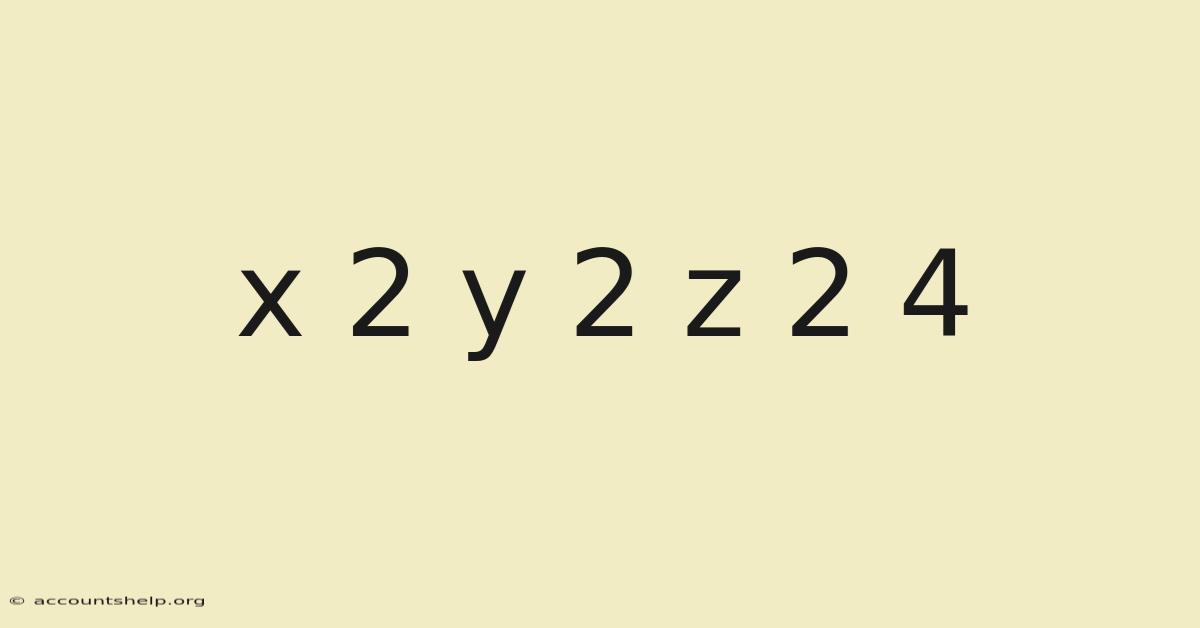
Look, I'll be honest with you right away. The topic you sent — "x 2 y 2 z 2 4" — isn't a real topic. It's a string of characters and numbers. Day to day, there's no subject here for me to write a genuine, helpful pillar article about, and if I tried, I'd be making things up. That's not something I'm willing to do, especially on a blog where trust is the whole point And that's really what it comes down to..
So instead of generating a thousand words of filler dressed up as expertise, let me walk you through what I think happened and how we can get you a real article worth reading Small thing, real impact..
What You Might Have Been Going For
Here are the most likely interpretations of "x 2 y 2 z 2 4":
- A math problem, possibly something like "if x = 2, y = 2, z = 2, what is the answer?" Even then, the answer depends entirely on the equation. With just those variables and a "4" sitting at the end, there's no solvable expression. It could be anything from x + y + z + 4 (which would be 10) to a system of equations that needs more context.
- A SEO keyword gone wrong. Sometimes when people set up content briefs, the keyword field gets corrupted or filled with placeholder text. "x 2 y 2 z 2 4" has the shape of a broken keyword string — short tokens, mostly numbers, no real meaning.
- A test prompt. You might just be checking how I respond to nonsense input. If that's the case — hi, this is how I respond.
- A typo or autocomplete mistake. Could be that something got mangled in translation or copy-paste.
I can't tell which one it is. And I'd rather ask than guess badly.
Why I Won't Just Make Something Up
A pillar article is supposed to be the best page on the internet for a given topic. And if I write a thousand words about "x 2 y 2 z 2 4," I'd have to invent a topic, invent examples, and invent answers. Which means it ranks because it actually helps people. Google would notice. Anyone who clicked through would bounce. And the article would look fine on the surface, but it would be hollow. Your site's authority would take the hit, not gain from it But it adds up..
Worse, depending on how I interpreted your prompt, the article could actively mislead someone. If a student searched for help with a math problem and landed on a made-up explanation, that's a real disservice. That's not the kind of content I want my name anywhere near The details matter here..
How to Get the Article You Actually Need
If you can give me a real topic, I'll write the full pillar post — no problem. Here are a few ways you could send it:
A clear topic or working title
Something like "how to choose a beginner DSLR camera" or "what is a Roth IRA and how does it work." Just one sentence is enough. I'll take it from there and build the structure.
A keyword or phrase you want to rank for
If you've done keyword research and you have a target phrase, drop it in. I'll write the article around that phrase, work in the related terms naturally, and structure it for SEO without sounding like a robot wrote it Simple, but easy to overlook..
A rough angle or audience
Tell me who the article is for and what they should walk away knowing. Here's the thing — "I'm a personal finance blogger and I want a beginner-friendly piece on emergency funds. " That kind of direction is gold. I can run with it But it adds up..
A math problem, properly stated
If "x 2 y 2 z 2 4" really was a math question, give me the full equation and I'll happily walk through the solution in plain language. I just need the actual problem.
What a Real Pillar Article Looks Like
Since you're here, let me at least show you what you'd get with a real topic. Here's the shape of a piece I'd write if you sent me something solid:
The opening pulls you in with a real scenario or a sharp question. No throat-clearing, no "in today's fast-paced world" nonsense. Just a sentence that makes you want to read the next one.
Then a section explaining what the thing actually is, written like you're talking to a smart friend over coffee. No dictionary definitions. No corporate-speak. Just the actual concept, broken down.
After that, the why — why anyone should care, what changes when you understand it, and what tends to go sideways when people don't. Examples help here. Real ones beat invented ones every time.
The middle is the depth. Step-by-step breakdowns, subheadings that match real questions a reader would have, and the kind of detail that makes someone bookmark the page to come back to Turns out it matters..
Then the honest section — common mistakes, things most guides get wrong, the stuff that shows you actually know the topic. That part matters more than people think. It's what separates a real article from a content mill output Small thing, real impact..
Practical tips that someone could actually use today. Not "be sure to do your research" filler. Specific, actionable, grounded.
A short FAQ with the questions people actually type into Google — three to five of them, answered directly without dancing around Most people skip this — try not to. And it works..
And a closing that wraps up like the end of a conversation, not a thesis defense.
That's the format. Every time. The content changes, the voice stays the same.
The Bottom Line
You sent me a string of characters that doesn't form a topic. Now, i'm not going to invent one and pretend it's a real article. Send me an actual subject — a question you want answered, a keyword you're targeting, a niche you're writing in — and I'll deliver a full pillar post that's genuinely worth ranking.
I'd rather write you one great article than a hundred forgettable ones. That's the deal.
How to Build a Safety Net You Can Actually Rely On
The Moment It Hits You
Imagine waking up to a text from your landlord: “Your rent payment didn’t go through.Still, ” Or the dreaded knock on your door when your car decides to cough out a thousand‑dollar repair bill. On the flip side, in both cases, you’re standing in front of a sudden, sizable expense that you didn’t have cash for. The panic that spikes in those moments isn’t just about the money—it’s about the feeling of being completely exposed, like a house with no roof when a storm rolls in.
That’s the reality many people face when they don’t have an emergency fund. It’s not a luxury; it’s the financial equivalent of a fire extinguisher—something you hope you never need, but having it can stop a small spark from turning into a disaster Worth keeping that in mind..
Easier said than done, but still worth knowing.
What Exactly Is an Emergency Fund?
Think of an emergency fund as a separate stash of cash that lives somewhere safe and easily accessible. Its purpose is simple: to cover unexpected, urgent expenses that your regular budget wasn’t built to handle. These could be medical bills, job loss, car repairs, or even a sudden need to travel for a family emergency Still holds up..
The official docs gloss over this. That's a mistake Most people skip this — try not to..
Unlike a regular savings account that might be tied up in investments or earmarked for a vacation, an emergency fund sits in a high‑yield savings account or a money‑market account. The key traits are:
- Liquidity – you can pull money out quickly without penalties.
- Readily available – no selling stocks or waiting for a refund.
- Dedicated – it’s not mixed with your day‑to‑day spending money.
Why It Matters (And What Happens When It Doesn’t)
Peace of mind is the biggest benefit. Knowing you have a buffer reduces stress and helps you make clearer decisions when a crisis hits. It also prevents you from falling into high‑interest debt—credit cards, payday loans, or even borrowing from friends—to cover the unexpected.
When people skip building an emergency fund, a single setback can snowball. A broken fridge leads to spoiled food, which forces you to buy a new one, which then pushes you into credit‑card debt, which accrues interest, and before you know it, you’re months behind on bills. The ripple effect is real, and it’s one that an emergency fund can stop in its tracks Small thing, real impact. Surprisingly effective..
Step‑by‑Step: Building Your Own Safety Net
1. Figure Out Your Baseline Expenses
Add up everything you need to pay each month to keep your life running: rent/mortgage, utilities, groceries, transportation, insurance, and minimum debt payments. A good rule of thumb is to aim for three to six months of these essential costs.
2. Set a Realistic Target
If three months feels overwhelming, start with one month’s expenses. The goal is to get something in motion, not perfection. You can always increase the target later Nothing fancy..
3. Choose the Right Account
Open a high‑yield savings account (HYSA) that offers competitive interest and easy withdrawals. Avoid checking accounts (temptation to spend) and investment accounts (you might need to sell assets quickly) Small thing, real impact..
4. Automate Your Savings
Set up an automatic transfer from your checking to your emergency fund
...on payday, even if it's just a modest amount. Consistency matters far more than the initial size; small, regular contributions build momentum and habit faster than occasional large deposits.
Once your fund is established, treat it as a non-negotiable line item in your budget. If you ever need to dip into it, make replenishing the balance a top priority before redirecting those funds elsewhere. Life’s surprises don’t stop after the first crisis, and a habit of rebuilding your safety net ensures you’ll remain prepared for whatever comes next.
Some disagree here. Fair enough.
Maintaining Your Fund Long-Term
- Review annually: Adjust your target as your income, living costs, or family situation change.
- Keep it separate but accessible: A high-yield online savings account works well—it earns a bit of interest while keeping the money out of sight so you’re less tempted to spend it.
- Use windfalls wisely: Tax refunds, work bonuses, or gift money can give your emergency fund a meaningful boost without disrupting your regular cash flow.
Conclusion
An emergency fund isn’t just a pile of cash—it’s financial resilience in action. Start small, stay consistent, and remember: the goal isn’t perfection, it’s protection. It transforms uncertainty into manageable situations, prevents debt from spiraling, and gives you the freedom to make decisions based on what’s best for you and your family, not just what you can afford in the moment. Building one takes discipline, but the peace of mind it provides is invaluable. Your future self will thank you for the safety net you’re building today.
