The Puzzle That Breaks Brains
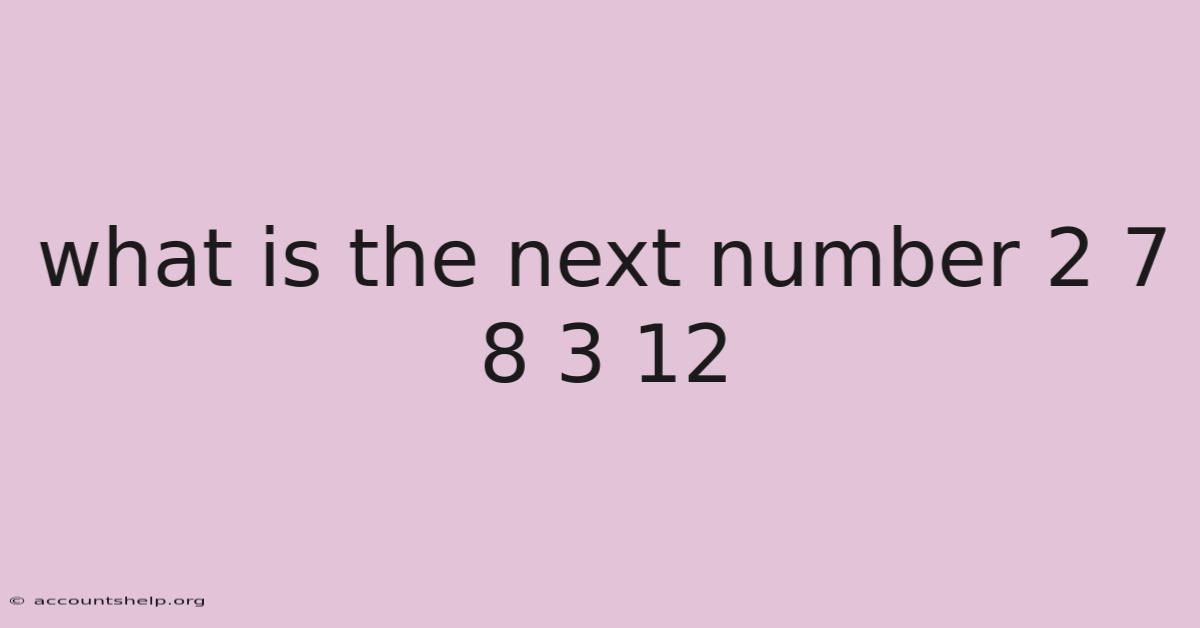
You've seen it a thousand times. A sequence flashes on a screen, a classroom whiteboard, or someone's Instagram story: 2, 7, 8, 3, 12, ?
And then the inevitable question: "What comes next?"
This isn't just a brain teaser — it's a window into how our minds work. Because of that, because here's the thing about number sequence puzzles: they're usually designed to make you feel clever, not to test anything real. That said, or, more accurately, how they think* they work. And this one? It's a masterclass in misdirection Practical, not theoretical..
Look at those numbers again. No clean multiplication pattern. There's no obvious arithmetic progression. Even so, that's the trap. Really look. No tidy Fibonacci-style addition. The puzzle wants you to force a mathematical rule where none cleanly exists, and the moment you do, you've already lost the plot.
So what is the next number? Well, that depends entirely on what you think the question is really asking Worth keeping that in mind..
What This Sequence Actually Is
Let's get something straight right away: 2, 7, 8, 3, 12 doesn't follow a single, clean mathematical rule. Not one that any reasonable person would call "the answer."
What it does* do is play with expectations. Here's what's happening:
- 2 → 7: That's +5
- 7 → 8: That's +1
- 8 → 3: That's -5
- 3 → 12: That's +9
The differences are: +5, +1, -5, +9. Still no obvious pattern. The jumps feel random. And that's the point That alone is useful..
This kind of sequence shows up in IQ tests and puzzle books not because it reveals mathematical genius, but because it reveals how desperately we want patterns to exist. We see a list of numbers and immediately start hunting for the rule, even when the rule might be "there is no rule."
Sometimes, the most honest answer to "what comes next?" is: "anything you want it to be."
Why These Puzzles Hook Us
Here's what's fascinating about sequences like this: they tap into something deep in human psychology. We are pattern-recognition machines. It's literally how we survived as a species — noticing that certain plants meant food, certain clouds meant rain, certain animal tracks meant danger It's one of those things that adds up..
But that survival mechanism doesn't shut off when we're looking at abstract numbers on a screen. Our brain screams at us to find the pattern, to crack the code, to be the person who figures it out Took long enough..
And puzzle creators know this. That said, they deliberately craft sequences that almost* make sense, that tease the edge of recognition without ever delivering a satisfying "aha" moment. That's why these puzzles spread so easily online — they create just enough tension to keep people engaged, but rarely enough resolution to actually satisfy Most people skip this — try not to. No workaround needed..
Real talk? Think about it: most of these sequences are less about logic and more about creative interpretation. The "correct" answer often depends on what the puzzle-maker was thinking that day. And since we don't have access to their brain, we're left guessing Which is the point..
How to Actually Approach Number Sequences
If you're going to tackle these puzzles seriously — whether for fun, for a test, or just to stop feeling frustrated — there's a method to the madness. Here's how to think about them:
Look for Multiple Layers
Don't just check one type of relationship. A sequence might combine several operations:
- Arithmetic: Adding or subtracting a consistent number
- Geometric: Multiplying or dividing by a consistent number
- Alternating patterns: Two separate sequences woven together
- Positional logic: The position of the number in the sequence matters
- Digit manipulation: Looking at the digits themselves, not the whole number
For 2, 7, 8, 3, 12, let's try the alternating approach:
- Odd positions (1st, 3rd, 5th): 2, 8, 12 → differences of +6, +4
- Even positions (2nd, 4th): 7, 3 → difference of -4
Hmm. Now, not clean, but there's something* there. The odd positions increase, the even positions decrease.
Check for Hidden Rules
Sometimes the rule isn't mathematical at all. Consider:
- Calendar dates: Maybe these are dates or months
- Letter counts: The number of letters in spelled-out numbers
- External references: Ages, addresses, jersey numbers
- Visual patterns: How the numbers look when written
Could 2, 7, 8, 3, 12 represent something else entirely? Maybe. Without more context, it's impossible to say.
Accept That Some Sequences Are Designed to Be Unsolvable
We're talking about the hardest part for most people. Not every puzzle has a satisfying answer. Some are designed to generate engagement — comments, shares, debates — rather than to be solved.
And honestly? That's okay. The value isn't always in finding the "right" answer. Sometimes it's in the process of thinking, questioning, and exploring different possibilities.
Common Mistakes People Make With These Puzzles
Here's where most people go wrong, and it's not about math. It's about mindset Simple, but easy to overlook..
Assuming There's One Right Answer
This is the biggest trap. Consider this: when you see **2, 7, 8, 3, 12, ? **, your brain wants to believe there's a single, elegant solution. But in reality, you can justify almost any next number with the right (or wrong) reasoning.
Someone could argue the next number is 5. Each could be defended with a different pattern or rule. Or 17. On top of that, or 1. The puzzle doesn't give you enough information to know which is "correct Easy to understand, harder to ignore..
Forcing Mathematical Rules
Not every sequence is mathematical. Some are linguistic, visual, or based on completely arbitrary rules that only make sense to the creator.
The moment you assume "this must be an arithmetic sequence," you've narrowed your thinking. You start ignoring possibilities that don't fit your preconceived notion of what a "pattern" should look like.
Overcomplicating the Solution
Sometimes the simplest answer is the right one. If you're doing complex calculus to figure out the next number in a sequence that appeared in a meme, you've probably gone off the rails.
Ignoring Context
Where did you encounter this sequence? Practically speaking, in a movie? In a math textbook? Worth adding: on a dating profile? The context often holds clues that the numbers alone don't provide.
What Actually Works When You're Stuck
So you're staring at 2, 7, 8, 3, 12 and nothing makes sense. Here's what helps:
Try the "Obvious" Answer First
Before you overthink it, consider the simplest possible patterns. Which means is there a basic arithmetic or geometric relationship? Even if it seems too simple, check it Most people skip this — try not to..
For this sequence, the differences between consecutive numbers are +5, +1, -5, +9. Not obvious, but not completely random either.
Look for Alternating or Split Sequences
This is the strategy that works most often with tricky sequences. Split the sequence into two (or more) separate patterns:
- 2, 8, 12 (positions 1, 3, 5)
- 7, 3 (positions 2, 4)
The first group increases, the second decreases. Maybe the next number continues the decreasing pattern of the even positions?
Consider the Source
If this came from a specific test, book, or website, look for the creator's style. Do they favor certain types of patterns? Are they known for being tricky or straightforward?
Embrace the Ambiguity
Sometimes the best approach is to acknowledge that multiple answers could be valid. On the flip side, pick the one that feels most satisfying to you, and move on. You're not failing the puzzle — you're recognizing its limitations Not complicated — just consistent..
FAQ: Number Sequence Questions
What is the next number in 2, 7, 8, 3, 12?
There's no single definitive answer. The sequence doesn't follow a standard mathematical pattern. That said, if you split it into alternating positions (2, 8, 12 and 7, 3), you might predict the next number continues
FAQ: Number Sequence Questions (Continued)
What is the next number in 2, 7, 8, 3, 12?
There’s no single definitive answer. The sequence doesn’t follow a standard mathematical pattern. Even so, if you split it into alternating positions (2, 8, 12 for odd positions and 7, 3 for even positions), you might predict the next number continues the decreasing trend in the even positions. To give you an idea, subtracting 4 again would yield -1. Alternatively, if you focus on the odd positions (2, 8, 12), you could argue the pattern increases by 6 each time, suggesting the next odd-position number is 18. Both answers are valid depending on the rule you prioritize The details matter here..
Conclusion
Number sequences are less about finding a "correct" answer and more about understanding the creative or logical framework behind them. The ambiguity in sequences like 2, 7, 8, 3, 12 highlights a broader truth: patterns are often subjective, shaped by context, intent, or even the whims of their creator. Whether you’re solving a puzzle, analyzing data, or decoding a message, the key takeaway is to remain flexible. Don’t let the pressure to find a single "right" answer stifle your curiosity. Instead, embrace the process of exploration—test hypotheses, question assumptions, and remember that sometimes the most satisfying solutions are the ones that defy logic. After all, in a world full of patterns, the ability to see beyond the obvious is what turns a simple sequence into a meaningful puzzle.
