The Sum Of Twice A Number And 13 Is 75.
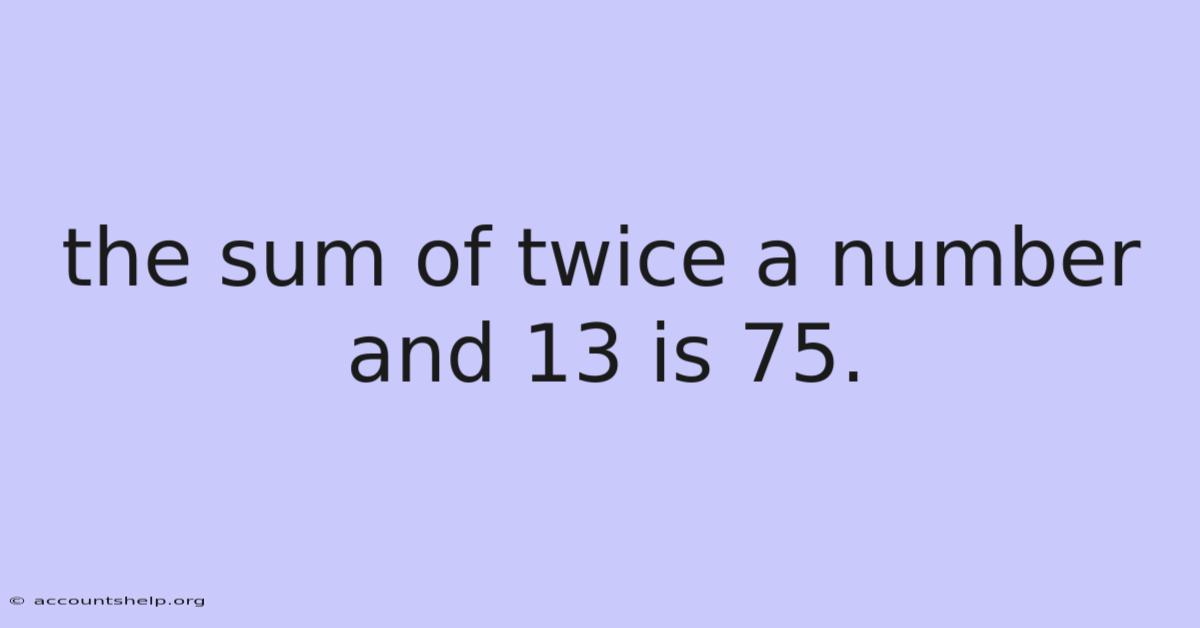
Have you ever stared at a math problem and felt that sudden, inexplicable urge to close your laptop and walk away? It happens to the best of us. You see a string of words like "the sum of twice a number and 13 is 75," and your brain immediately starts looking for an exit strategy.
It sounds like a riddle or a poorly written instruction manual. But here is the truth: these aren't just random sentences designed to annoy students. Now, they are the building blocks of logic. Once you learn how to translate these sentences into something manageable, you aren't just solving for $x$; you're learning how to deconstruct the world.
What Is This Problem Actually Saying?
When we talk about "the sum of twice a number and 13 is 75," we are looking at a classic algebraic sentence. In plain English, it's a puzzle where one piece is missing. We know the result, we know the relationship between the pieces, but we don't know the starting point.
Breaking Down the Vocabulary
To solve this, you have to stop seeing a sentence and start seeing operations. Math has its own dialect, and it's actually quite consistent once you get the hang of it.
First, there is the word sum. Because of that, in the world of math, "sum" is just a fancy way of saying addition. It tells you that two distinct entities are being joined together.
Then, we have twice a number. Practically speaking, this is where the mystery lies. "A number" is our unknown variable. We don't know if it's 5, 10, or 1,000. But "twice" tells us exactly what to do to that unknown number: multiply it by 2.
Finally, there is the word is. Also, in algebra, "is" functions as the equals sign ($=$). This is the most important word in the sentence. It acts as the fulcrum of a scale, telling you that the value on the left side must perfectly balance the value on the right side.
So, when you strip away the fluff, you're left with a very simple mathematical statement: $2x + 13 = 75$.
Why It Matters
You might be thinking, "I'm never going to go to the grocery store and calculate the sum of twice a number and 13." And you're probably right. You won't. But the logic used to solve this is everywhere.
The Logic of Variables
Every time you use an app that calculates your estimated arrival time based on your speed, you are interacting with algebra. Every time a programmer writes a line of code that says "if user clicks this, then do that," they are using variables.
The ability to take a complex, wordy situation and boil it down to its core components is a superpower. It's called modeling. Whether you're a business owner trying to figure out how many units you need to sell to cover your rent, or a scientist trying to predict how a chemical reaction will behave, you are doing exactly what this problem asks: you are defining what you know, identifying what you don't know, and finding the bridge between them.
When people struggle with math, it’s rarely because they can't do the arithmetic. It's because they can't translate the "human" language into the "math" language. If you can master this translation, you've won half the battle.
How to Solve It (The Step-by-Step Breakdown)
Let's stop talking and actually do the work. So naturally, there are a few ways to approach this, but the most reliable method is the isolation method. Our goal is to get that mysterious "number" all by itself on one side of the equals sign.
Step 1: Setting Up the Equation
As we established, we translate the words into symbols. "Twice a number" $\rightarrow 2x$ "Sum of... and 13" $\rightarrow + 13$ "Is 75" $\rightarrow = 75$
Our equation is: $2x + 13 = 75$
Step 2: Undoing the Addition
In algebra, you often have to work backward. Practically speaking, to get $x$ alone, we need to get rid of that $+ 13$. How do you undo addition? You use subtraction. This is the principle of inverse operations.
To keep the equation balanced, whatever you do to one side, you must do to the other. If we subtract 13 from the left, we have to subtract 13 from the right.
$2x + 13 - 13 = 75 - 13$ $2x = 62$
Now the problem looks much friendlier. We've gone from a two-step puzzle to a one-step puzzle.
Step 3: Undoing the Multiplication
We are almost there. Right now, we have $2x$, which means "2 times $x$.Still, " To isolate $x$, we need to undo that multiplication. The inverse of multiplication is division.
We divide both sides by 2.
For more on this topic, read our article on equation for newton's universal law of gravitation or check out relationship between speed and kinetic energy.
$2x / 2 = 62 / 2$ $x = 31$
And there it is. The mystery number is 31.
Step 4: The Reality Check
I always tell people: never trust a solution until you've tested it. This is the part that separates the pros from the amateurs. Take your answer (31) and plug it back into the original word problem.
Does "twice 31" plus 13 equal 75? $31 \times 2 = 62$ $62 + 13 = 75$
It works. The math is solid.
Common Mistakes / What Most People Get Wrong
If you're working through these problems on your own, you're going to hit roadblocks. It's not because you aren't smart; it's because algebra has some specific traps that are very easy to fall into.
The "Sign" Trap
This is the most common error. So naturally, people often lose track of whether a number is positive or negative. Think about it: in our problem, the 13 was being added. Even so, if the problem had said "the difference of twice a number and 13 is 75," that 13 would be negative. If you treat a negative as a positive, the whole house of cards falls down.
The "Balance" Error
I see this all the time: someone subtracts 13 from the left side but forgets to do it to the right side. They think, "Well, I only need to get $x$ alone, so I don't need to touch the other side."
That's not how it works. That said, an equation is a scale. If you take a weight off one side, the scale tips. Practically speaking, to keep it level, you must take the same weight off the other side. If you don't, you aren't solving the original problem anymore; you're solving a completely different one.
Misinterpreting "Twice"
Sometimes people see "twice a number and 13" and think it means $2(x + 13)$. Consider this: they add the 13 first and then double the whole thing. But the phrasing matters. Which means "The sum of (twice a number) and (13)" is different from "Twice the sum of a number and 13. " Order of operations is everything.
Practical Tips for Mastering Algebra
If you're looking to get better at this, don't just memorize formulas. That's why memorizing is for people who want to pass a test and immediately forget everything. Understanding is for people who want to actually use the skill.
- Draw it out. If a problem feels too abstract, draw a box for the unknown number. Sometimes seeing it visually helps your brain process the relationship.
- Write out every single step. Don't try to do the mental math in your head. When you do the math in your head, you lose the "trail" of your logic. If you make a mistake, you won't know where you went wrong. If you write it down, you can see exactly where the error happened.
- Learn the vocabulary first. If you can't distinguish between "product," "quotient,"
sum, and difference, the word problems will feel like riddles written in a foreign language. Spend a few minutes drilling these terms until they become second nature.
- Check your work every single time. Even if you're convinced you're right, plug your answer back into the original equation. This one habit will catch 90% of your mistakes before they become frustrating dead ends.
Real-World Applications
You might be wondering, "When am I ever going to use this?" The answer is: more often than you think. Algebra isn't just busywork—it's the foundation for everything from calculating interest rates to understanding how search engines rank web pages.
If you're designing a budget, you're using algebraic thinking to balance income and expenses. On top of that, if you're planning a road trip, you're solving for time, distance, and speed. The ability to translate a real-world situation into a mathematical equation—and then solve it—is one of the most valuable skills you can develop.
Conclusion
Mastering algebra word problems isn't about having a "math brain." It's about developing a systematic approach: read carefully, define your variable, translate the words into symbols, solve step by step, and always verify your answer.
The students who struggle the most aren't necessarily the ones who can't do the math—they're the ones who rush through the setup or skip the checking phase. Slow down, trust the process, and remember that every expert was once a beginner. With practice and patience, these problems will go from intimidating puzzles to straightforward exercises.
Latest Posts
Just In
-
How Many Electrons Are In An Orbital
Aug 01, 2026
-
How To Determine Ph From Molarity
Aug 01, 2026
-
Population Of Organisms That Can Interbreed
Aug 01, 2026
-
How To Find Class Midpoints In Statistics
Aug 01, 2026
-
How Many Neutrons Are In Chlorine 37
Aug 01, 2026
Related Posts
On a Similar Note
-
Which Is A Non Membrane Bound Organelle
Aug 01, 2026
-
How To Solve For Limiting Reagent
Aug 01, 2026
-
How Many Electrons In The F Orbital
Aug 01, 2026
-
Length Of Segment Of Circle Formula
Aug 01, 2026
-
What Type Of Tissue Is Avascular
Aug 01, 2026
