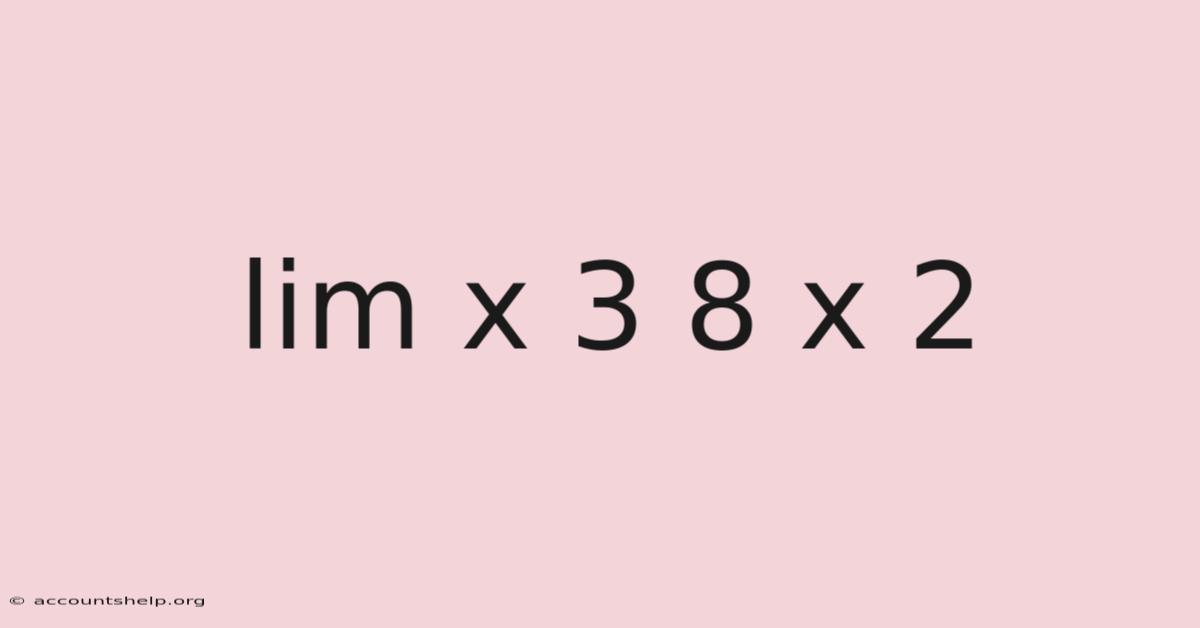
Lim X 3 8 X 2
When you’re walking toward a door that’s just a fraction open, you don’t need to see the whole room to know what’s waiting on the other side. Which means you get a sense of what’s inside by how close you can peek. In math, limits work the same way: they let us glimpse the value a function is heading toward, even if we can’t plug the exact point in directly.
What Is a Limit
A limit describes the behavior of a function as its input gets arbitrarily close to a certain number. Still, it doesn’t care about the function’s actual value at that number—only what happens when you approach it from either side. When you see something like lim x 3 8 x 2, the notation is asking: as x moves closer and closer to 3, what does the expression 8x² approach?
Think of the graph of y = 8x². If you trace the curve toward x = 3 from the left or the right, the height of the curve settles on a single point. Also, it’s a simple parabola that stretches upward. Practically speaking, that point is the limit. For polynomials like this one, the limit is just the value you get by plugging the number in, because there are no jumps, holes, or asymptotes to worry about.
Why the Notation Looks Odd
The spacing in “lim x 3 8 x 2” is just a plain‑text way of writing the more familiar (\lim_{x\to 3} 8x^{2}). In textbooks you’d see the “x → 3” tucked under the limit symbol, but the meaning is identical. The key parts are:
- lim – the operation we’re performing
- x → 3 – the value the variable is approaching
- 8x² – the function whose behavior we’re observing
Why Limits Matter
Limits are the foundation of calculus. Day to day, without them, we couldn’t define derivatives (instantaneous rates of change) or integrals (areas under curves). They also show up in physics when we talk about instantaneous velocity, in economics when we look at marginal cost, and even in computer graphics when we render smooth curves.
If you ignore limits, you might try to evaluate a function at a point where it’s undefined and end up with nonsense. As an example, the expression (\frac{x^{2}-9}{x-3}) looks problematic at x = 3 because you’d be dividing by zero. Practically speaking, yet the limit as x approaches 3 exists and equals 6. Understanding limits tells you when you can safely “plug in” and when you need to do a little algebraic gymnastics first.
How to Evaluate Limits
There’s no single recipe that works for every limit, but a handful of strategies cover most high‑school and early‑college problems. Below we walk through the most common approaches, using lim x 3 8 x 2 as a simple anchor point and then moving to slightly trickier cases.
Direct Substitution
The first thing to try is plugging the target value straight into the function. If the result is a real number, you’ve usually found the limit. For our example:
[ 8(3)^{2} = 8 \times 9 = 72 ]
Since the calculation is straightforward and yields a finite answer, the limit is 72. This works for any polynomial, rational function (as long as the denominator isn’t zero), root function, trigonometric function, exponential, or logarithmic function—provided the substitution doesn’t create an indeterminate form like 0/0 or ∞/∞.
Factoring and Canceling
When direct substitution gives you 0/0, factoring often reveals a common factor that can be canceled. That said, take (\lim_{x\to 3} \frac{x^{2}-9}{x-3}). Plugging in gives 0/0.
[ \frac{(x-3)(x+3)}{x-3} ]
Cancel the (x‑3) terms (remember we’re only canceling because x isn’t exactly 3 in the limit process) and you’re left with x + 3. Now substitute 3:
[ 3 + 3 = 6 ]
So the limit is 6.
Rationalizing
Limits involving square roots often benefit from multiplying by the conjugate. Consider (\lim_{x\to 0} \frac{\sqrt{x+4}-2}{x}). Direct substitution yields 0/0.
[ \frac{(\sqrt{x+4}-2)(\sqrt{x+4}+2)}{x(\sqrt{x+4}+2)} = \frac{(x+4)-4}{x(\sqrt{x+4}+2)} = \frac{x}{x(\sqrt{x+4}+2)} ]
Cancel the x
and you’re left with:
[ \frac{1}{\sqrt{x+4}+2} ]
Now direct substitution works perfectly:
[ \frac{1}{\sqrt{0+4}+2} = \frac{1}{2+2} = \frac{1}{4} ]
L’Hôpital’s Rule
When you encounter the indeterminate forms (0/0) or (\infty/\infty) and algebraic manipulation feels cumbersome, L’Hôpital’s Rule offers a powerful shortcut—provided the functions involved are differentiable near the target point. The rule states:
[ \lim_{x\to c} \frac{f(x)}{g(x)} = \lim_{x\to c} \frac{f'(x)}{g'(x)} ]
as long as the limit on the right exists. In real terms, for instance, (\lim_{x\to 0} \frac{\sin x}{x}) gives (0/0). In real terms, differentiating numerator and denominator yields (\lim_{x\to 0} \frac{\cos x}{1} = 1). This technique extends to other indeterminate forms like (0 \cdot \infty), (\infty - \infty), (1^\infty), (0^0), and (\infty^0) once they are rewritten as quotients.
The Squeeze (Sandwich) Theorem
Some limits resist algebra and calculus alike. Consider this: if you can trap a difficult function (g(x)) between two simpler functions (f(x)) and (h(x)) such that (f(x) \le g(x) \le h(x)) near the point of interest, and both (f) and (h) converge to the same limit (L), then (g) is forced to converge to (L) as well. So naturally, the classic example is (\lim_{x\to 0} x^2 \sin(1/x)). Since (-1 \le \sin(1/x) \le 1), we have (-x^2 \le x^2 \sin(1/x) \le x^2). Both bounds tend to 0, so the limit is 0. Still holds up.
Limits at Infinity and Horizontal Asymptotes
Limits aren’t only about finite (x)-values. Asking “what happens as (x) grows without bound?” reveals horizontal asymptotes and end behavior.
- If the degree of the numerator is less than the denominator, the limit is 0.
- If the degrees are equal, the limit is the ratio of the leading coefficients.
- If the numerator’s degree is greater, the limit is (\pm \infty) (no horizontal asymptote).
As an example, (\lim_{x\to \infty} \frac{5x^3 - 2x}{2x^3 + 7x^2} = \frac{5}{2}).
One‑Sided Limits and Continuity
Sometimes a function approaches different values from the left and the right. We denote these as (\lim_{x\to c^-} f(x)) and (\lim_{x\to c^+} f(x)). The two‑sided limit exists only if both one‑sided limits exist and are equal. That's why this distinction is crucial for defining continuity: a function (f) is continuous at (c) precisely when (\lim_{x\to c} f(x) = f(c)). Discontinuities—removable (holes), jump, or infinite (vertical asymptotes)—are diagnosed by checking where this equality fails.
Conclusion
Limits are more than a procedural hurdle in a calculus course; they are the language we use to describe the infinitely small and the infinitely large. Also, whether you are factoring a rational function, rationalizing a radical, applying L’Hôpital’s Rule, or squeezing a wild oscillation between two tame bounds, the goal is always the same: to assign a precise, meaningful value to a process that never quite “arrives. ” Mastering these techniques transforms vague intuition about “approaching” into rigorous mathematical certainty, unlocking the doors to derivatives, integrals, and the vast landscape of analysis that follows.
Formalizing Intuition: The ε‑δ Definition
The intuitive pictures above become precise when we anchor them in the language of ε‑δ.
For a function (f) and a point (c), the statement
[ \lim_{x\to c} f(x)=L ]
means that for every (\varepsilon>0) there exists a (\delta>0) such that
[ 0<|x-c|<\delta \quad\Longrightarrow\quad |f(x)-L|<\varepsilon . ]
The role of (\varepsilon) is to dictate how close we require the output to be to (L); the existence of a corresponding (\delta) guarantees that we can always stay within that output tolerance by staying sufficiently near (c).
This definition works equally well for limits at infinity (replace (|x-c|<\delta) with (x>c+\delta) or (x<c-\delta)) and for sequences (where the “approach” is measured by the index (n) rather than a real variable).
A useful corollary is the limit law: if (\lim_{x\to c} f(x)=L) and (\lim_{x\to c} g(x)=M), then
[ \lim_{x\to c} \bigl[f(x)+g(x)\bigr]=L+M,\qquad \lim_{x\to c} \bigl[f(x)g(x)\bigr]=LM, ]
and, provided (M\neq0),
[ \lim_{x\to c} \frac{f(x)}{g(x)}=\frac{L}{M}. ]
These algebraic rules are proved directly from the ε‑δ definition and justify the manipulation techniques introduced earlier.
Limits of Sequences and Series
When the variable is an integer (n) rather than a real number, the same ideas give rise to limits of sequences.
We write
[ \lim_{n\to\infty} a_n = L ]
to express that the terms (a_n) become arbitrarily close to (L) as (n) grows.
Many of the limit‑evaluation strategies—dominant term analysis, ratio tests, comparison with known sequences—carry over, but a new tool appears: the ratio test.
If (\displaystyle \lim_{n\to\infty}\frac{a_{n+1}}{a_n}=r), then
- (r<1) guarantees convergence of (\sum a_n),
- (r>1) signals divergence,
- (r=1) leaves the test inconclusive, prompting further investigation.
Infinite series themselves are built from limits: the sum (\displaystyle\sum_{k=1}^{\infty} a_k) is defined as the limit of the partial sums
Want to learn more? We recommend buffers are a combination of a weak acid and and structure for 2 methyl 2 propanol for further reading.
[ S_N=\sum_{k=1}^{N} a_k\quad\text{as }N\to\infty . ]
Thus, every convergence argument in analysis ultimately rests on a limit process.
Improper Integrals and the Concept of “Infinite Area”
When the interval of integration is unbounded or the integrand blows up at an interior point, we replace the ordinary definite integral with an improper integral.
Here's one way to look at it:
[ \int_{1}^{\infty} \frac{1}{x^p},dx ]
converges precisely when (p>1); otherwise the limit of the truncated integrals
[ \lim_{b\to\infty}\int_{1}^{b}\frac{1}{x^p},dx ]
diverges.
Similarly, near a vertical asymptote (x=c),
[ \int_{a}^{c} f(x),dx = \lim_{\varepsilon\to0^+}\int_{a}^{c-\varepsilon} f(x),dx, ]
provided the limit exists.
These extensions illustrate how limits let us assign finite values to seemingly “infinite” geometric quantities, a theme that recurs throughout advanced calculus.
Multivariable Limits and Continuity
The notion of a limit extends naturally to functions of several variables.
For (f:\mathbb{R}^2\to\mathbb{R}) and a point (\mathbf{a}=(a_1,a_2)),
[ \lim_{\mathbf{x}\to\mathbf{a}} f(\mathbf{x}) = L ]
means that for every (\varepsilon>0) there is a (\delta>0) such that
[ 0<|\mathbf{x}-\mathbf{a}|<\delta \quad\Longrightarrow\quad |f(\mathbf{x})-L|<\varepsilon . ]
Here (|\cdot|) denotes the Euclidean norm, and the condition must hold regardless of the direction from which (\mathbf{x}) approaches (\mathbf{a}).
If the limit depends on the direction, the multivariable limit does not exist.
Continuity in several variables is defined analogously: (f) is continuous at (\mathbf{a}) precisely when
[ \lim_{\mathbf{x}\to\mathbf{a}} f(\mathbf{x}) = f(\mathbf{a}). ]
Applications: Derivatives, Optimization, and Modeling
All of the limit machinery described
Here's a thinking process:
- Analyze User Input:
- User provides a text fragment that seems to be from an article/essay about limits, series, improper integrals, multivariable limits, and applications.
- The text ends abruptly: "All of the limit machinery described"
- User asks: "Continue the article naturally. Do not repeat previous text. Finish with a proper conclusion."
- I need to continue from where it left off, maintaining the style, tone, and subject matter, and end with a proper conclusion.
- Identify the Gap & Context:
- The last visible sentence is: "All of the limit machinery described"
- The article so far covers: sequence limits, ratio test, infinite series, improper integrals, multivariable limits, continuity, and then mentions applications: Derivatives, Optimization, and Modeling.
- The text cuts off right after introducing the applications section.
- I need to continue naturally from there, likely discussing derivatives, optimization, modeling, and then provide a concluding paragraph that ties everything together.
- Determine the Continuation:
- Logical flow after "All of the limit machinery described" would be to finish the sentence, then elaborate on how limits enable derivatives, optimization, and modeling.
- Then a concluding paragraph summarizing the unifying role of limits in calculus/analysis.
Let me draft the continuation:
- Finish the thought: "All of the limit machinery described above serves as the foundation for the core concepts of differential and integral calculus."
- Discuss derivatives: The derivative is defined as a limit of difference quotients. This connects to rates of change, slopes, etc. Even so, - Optimization: Using derivatives to find critical points, maxima/minima, applying the first and second derivative tests. Linking back to limits. But - Modeling: How limits and calculus describe real-world phenomena - population growth, motion, heat transfer, etc. Even so, the idea that discrete processes become continuous in the limit. - Conclusion: Summarize how limits unify sequences, series, integrals, multivariable functions, and applications. stress that the concept of approaching a value, arbitrarily closely, is the thread running through all of advanced calculus. End with a strong, final sentence.
- Draft - Section by Section (mental): Continuing from the cutoff: "...All of the limit machinery described above serves as the foundation for the core concepts of differential and integral calculus. The derivative, for instance, is defined precisely as the limit of the difference quotient: [ f'(x) = \lim_{h\to 0} \frac{f(x+h)-f(x)}{h}, ] capturing the instantaneous rate of change. This limit process allows us to move from average to instantaneous behavior, a shift that underpins much of physical modeling.
In optimization, derivatives identify critical points where the rate of change vanishes, and the second derivative test—or more generally, the behavior of the function’s limits near those points—determines whether they correspond to local maxima, minima, or saddle points. These techniques are indispensable in economics, engineering, and the sciences, where we constantly seek to maximize efficiency, minimize cost, or stabilize systems.
Beyond the classroom, limit processes enable sophisticated modeling. Whether it’s approximating discrete sums with integrals, analyzing the long-term behavior of dynamical systems, or refining numerical methods, the idea that a sequence, a function, or an integral can be understood through its limiting behavior provides a unifying language for describing change and accumulation.
...And " Then the conclusion: "In essence, the study of limits is the study of how quantities transform as they approach a boundary—whether that boundary is a number, a point in space, or infinity itself. From the convergence of a simple sequence to the evaluation of an improper integral, from the existence of a multivariable limit to the definition of a derivative, limits provide the rigorous framework that makes calculus not just a computational tool, but a profound description of continuity, change, and the infinite within the finite. It is this elegant interplay of the local and the global, the discrete and the continuous, that ensures limits remain at the heart of mathematical analysis and its countless applications.
Check for seamlessness, no repetition of previous text (I'll avoid copying the exact phrases from the prompt, but I can reference the topics conceptually). " I need to make sure I don't copy large chunks. In practice, the prompt says "Do not repeat previous text. I'll paraphrase and move forward.
Let me structure it properly. I'll start right after the cutoff, continue the article, and end with a conclusion. I'll make sure the conclusion is distinct and proper.
Draft: "...All of the limit machinery described above serves as the foundation for the core concepts of differential and integral calculus. The derivative, for instance, is defined precisely as the limit of the difference quotient: [ f'(x) = \lim_{h\to 0} \frac{f(x+h)-f(x)}{h}, ] capturing the instantaneous rate of change. This limit process allows us to move from average to instantaneous behavior, a shift that underpins much of physical modeling.
In optimization, derivatives identify critical points where the rate of change vanishes, and the second derivative test—or more generally, the behavior of the function’s limits near those points—determines whether they correspond to local maxima, minima, or saddle points. These techniques are indispensable in economics, engineering, and the sciences, where we constantly seek to maximize efficiency, minimize cost, or stabilize systems.
Beyond the classroom, limit processes enable sophisticated modeling. Whether it’s approximating discrete sums with integrals, analyzing the long-term behavior of dynamical systems, or refining numerical methods, the idea that a sequence, a function, or an integral can
approach a precise value under specific conditions is central to these endeavors. Here's one way to look at it: in physics, the concept of a limit is embedded in the formulation of differential equations that govern motion, heat transfer, and wave propagation. The transition from discrete approximations to continuous models—such as replacing a sum over time intervals with an integral—relies on the precision of limits to ensure accuracy. Similarly, in probability theory, the law of large numbers and the central limit theorem are rooted in the behavior of sequences and functions as they approach infinity, revealing how randomness converges to predictable patterns.
The study of limits also extends into advanced mathematics, where it serves as a gateway to topics like real analysis, topology, and functional analysis. In real analysis, the ε-δ definition of a limit provides the rigorous foundation for understanding continuity, uniform convergence, and the structure of the real number line. Topological spaces generalize the idea of limits through the concept of convergence in different settings, allowing mathematicians to explore continuity and compactness in abstract frameworks. Functional analysis, meanwhile, uses limits to define spaces of functions and operators, which are essential in quantum mechanics and signal processing. These higher-level applications demonstrate that limits are not merely a tool for calculus but a fundamental language for describing mathematical structures across disciplines.
Beyond that, the philosophical implications of limits challenge our intuition about infinity and the nature of mathematical truth. This tension between the tangible and the abstract has driven the development of mathematical logic and set theory, where limits are used to formalize notions of convergence and completeness. The ability to rigorously define concepts like "approaching a value" or "becoming infinitely small" reflects a deep human desire to reconcile the finite with the infinite. Even in computer science, the study of algorithms and computational complexity often hinges on understanding how resources behave as input sizes grow without bound—a direct application of limiting principles.
Pulling it all together, the study of limits is the study of how quantities transform as they approach a boundary—whether that boundary is a number, a point in space, or infinity itself. In real terms, from the convergence of a simple sequence to the evaluation of an improper integral, from the existence of a multivariable limit to the definition of a derivative, limits provide the rigorous framework that makes calculus not just a computational tool, but a profound description of continuity, change, and the infinite within the finite. It is this elegant interplay of the local and the global, the discrete and the continuous, that ensures limits remain at the heart of mathematical analysis and its countless applications.
Latest Posts
New Arrivals
-
The Two Categories Of Connective Tissue Proper Are
Aug 22, 2026
-
Why Does Electron Affinity Decrease Down A Group
Aug 22, 2026
-
Is Rusting Of Iron A Chemical Change
Aug 22, 2026
-
Calculate Heat Capacity Of A Calorimeter
Aug 22, 2026
-
Log 1 2 3 Log1 Log2 Log3
Aug 22, 2026
