A 2x 3 9x 15 X
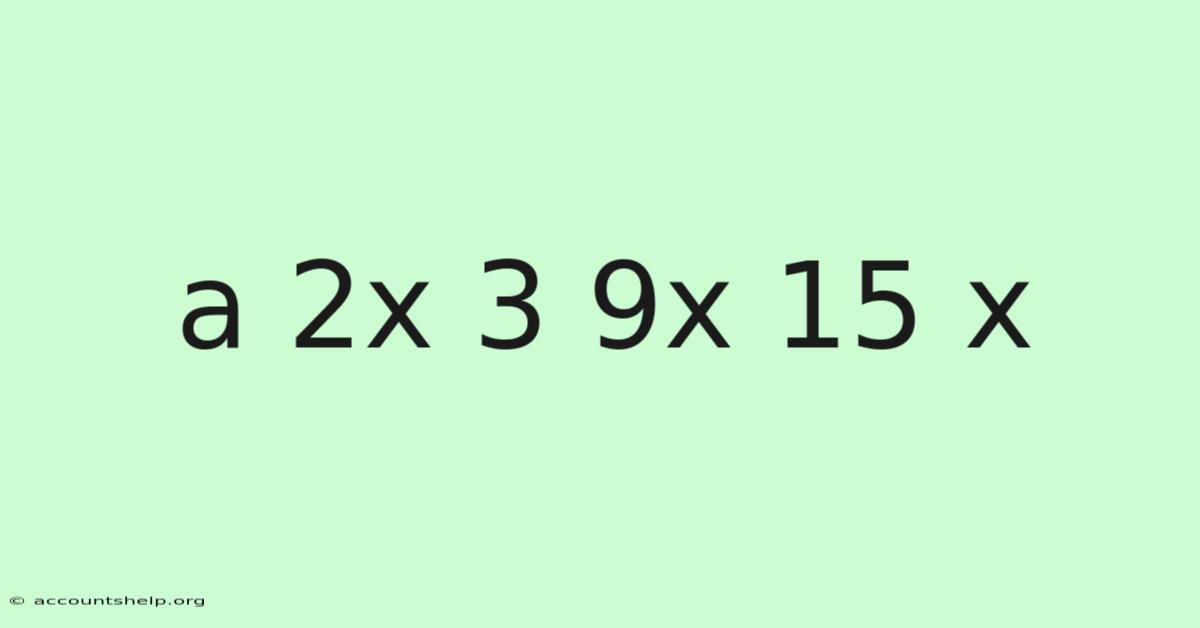
The Math Problem That Trips Up Almost Everyone
Here's the thing — most people look at 2x × 3 × 9x × 15x and immediately want to reach for a calculator. But this isn't a calculation problem. It's a pattern recognition problem. And once you see the pattern, it clicks instantly.
I've watched students stare at expressions like this for minutes, convinced they're missing some advanced trick. The truth? Day to day, it's simpler than it looks. But only if you approach it the right way.
What This Expression Actually Is
Let's strip away the intimidation. 2x × 3 × 9x × 15x is just four terms multiplied together — two constants and two variable terms. That's it. And no hidden calculus, no secret formulas. Just multiplication.
But here's where people trip up: they try to multiply everything at once instead of grouping strategically. The smart move is to separate the numbers from the variables, multiply the numbers together, then handle the x terms.
Why This Matters More Than You Think
Algebra isn't just schoolwork. In real terms, it's the foundation for everything from calculating interest on a mortgage to understanding how algorithms work. When you can look at a messy expression and see the underlying structure, you're training your brain to find order in chaos.
And honestly? Because of that, that skill pays off everywhere. Whether you're budgeting, planning a project, or debugging code, the ability to break down complex problems into manageable pieces is invaluable.
How to Solve It Step by Step
Step 1: Rearrange for Clarity
Don't work left to right. That's how mistakes happen. Instead, group the constants together and the variable terms together:
2x × 3 × 9x × 15x = (2 × 3 × 9 × 15) × (x × x × x)
This is legal because multiplication is commutative — you can rearrange the order without changing the result.
Step 2: Multiply the Constants
Now tackle 2 × 3 × 9 × 15. Break it down:
2 × 3 = 66 × 9 = 5454 × 15 = 810
So the constant part is 810.
Step 3: Handle the Variables
You have three x terms: x × x × x = x³
Step 4: Combine Everything
2x × 3 × 9x × 15x = 810x³
That's your answer. Clean, simple, done.
Common Mistakes People Make
Multiplying Left to Right
This is the #1 error. Someone sees 2x × 3 first and gets 6x, then multiplies by 9x to get 54x², then by 15x... and somewhere in that chain, they lose track. Working systematically beats working sequentially every time.
Forgetting to Count Variables
I've seen people multiply the numbers correctly but then write 810x instead of 810x³. Why? Because they stopped counting after the second x. In real terms, always write out your variable terms explicitly: x × x × x. It's harder to mess up.
Mixing Up Coefficients and Variables
Some students try to multiply 2x × 9x as 18x instead of 18x². Consider this: the x terms multiply too. Here's the thing — every time. Don't skip that step.
Practical Tips That Actually Work
Circle Like Terms First
Before touching your pencil to multiply, scan the expression and circle groups that belong together. In practice, constants here, x terms there. This visual separation prevents mental overload.
Use Estimation to Check Yourself
If you got 810x³, ask: does that make sense? Here's the thing — close enough. Well, 2 × 3 × 9 × 15 should be somewhere around 2 × 3 × 10 × 15 = 900. If you got 810x or 81x³, something went wrong.
Write Out Intermediate Steps
Even if you can do parts in your head, write them down. The extra second saves you from backtracking later.
Variations You'll Actually Encounter
This exact problem won't show up on every test. But variations will. Here are the patterns to recognize:
More terms: 4x × 5 × 2x × 7 × 3x — same approach, more numbers.
Negative signs: -2x × 3 × 9x × -15x — watch the signs. Two negatives make a positive.
Fractions: ½x × 4 × 3x × 6x — multiply fractions normally, then handle x terms.
The core strategy never changes. Group, multiply numbers, multiply variables, combine.
Why Some People Still Struggle
Honestly? They see too many letters and numbers and freeze. It's usually confidence. The fix is practice with simpler versions first.
Start with 2x × 3x. Got it? That's 24x². Now try 2x × 3 × 4x. That's 6x². Build up gradually.
Another issue: people forget that x without an exponent is x¹. So when you multiply x × x, you're adding exponents: x¹ × x¹ = x². Same rule applies no matter how many terms you have.
Quick Mental Math Tricks
Want to multiply 2 × 3 × 9 × 15 faster?
2 × 3 = 69 × 15 = 135(think10 × 15 - 15)6 × 135 = 810
Or rearrange: 2 × 15 = 30, then 3 × 9 = 27, then 30 × 27 = 810.
Either way works. Pick what feels natural.
When This Shows Up In Real Life
Engineering formulas often involve multiplying multiple terms with variables. Physics equations? Still, same thing. Even financial models use this kind of multiplication when compounding factors together.
Understanding how to handle 2x × 3 × 9x × 15x isn't about memorizing one problem. It's about building the mental muscle to tackle any similar expression that comes your way.
FAQ
Q: Can I use a calculator for this? A: You can, but you'll waste time entering each term separately. Recognizing the structure and simplifying first is faster.
Q: What if there are different variables, like x and y?
A: Same approach — group like variables together. x terms with x terms, y terms with y terms.
Q: How do I know when to stop simplifying? A: When all constants are multiplied together and all like variables are combined into single terms with exponents.
Q: Is there a general formula for this type of problem? A: Not really — it's about applying basic multiplication rules consistently. The pattern is always the same, even if the numbers change.
Q: What's the most common mistake on tests? A: Sign errors and forgetting to add exponents when multiplying variables. Slow down on those parts.
The Real Takeaway
Math problems like 2x × 3 × 9x × 15x aren't designed to trick you. They're designed to test whether you can see structure in apparent chaos. Once you stop trying to memorize steps and start looking for patterns, algebra becomes a lot less scary.
The answer is 810x³. But more importantly, you now have a system that works for any similar problem. That's worth a lot more than getting one question right.
And that's the difference between memorizing math and actually understanding it.
Turning Theory Into Habit
The moment you start treating each factor as a building block rather than a jumble of symbols, the whole process feels almost automatic. Here’s a quick routine you can adopt the next time a string of numbers and letters lands on your page:
-
Separate the constants from the variables.
Write down all the numeric multipliers on one line and all the alphabetic terms on another. This visual split makes it easier to see how many of each you’re dealing with.Want to learn more? We recommend what is the lewis structure of brf5 and how are archaebacteria different from eubacteria for further reading.
-
Combine the constants first.
Multiply the numbers together — often you can do this mentally by pairing friendly digits (e.g., 2 × 5 = 10, 4 × 25 = 100). The result becomes the coefficient of your final term. -
Add the exponents of identical variables.
Every time you see the same letter, note its exponent. If a variable appears without an explicit power, treat it as having an exponent of 1. Sum those exponents; the total becomes the new power for that letter. -
Write the simplified expression in a tidy form.
Place the combined coefficient in front, followed by each variable raised to its summed exponent, ordered alphabetically or by descending power — whichever feels most natural to you. -
Double‑check for hidden pitfalls.
Look out for negative signs, parentheses that might have been omitted, and any implied multiplication that could change the order of operations. A quick sanity check — plug in a simple value for the variable (like x = 1) — can confirm that your simplified result behaves as expected.
Practicing this five‑step loop a handful of times a day will embed the logic so deeply that you’ll start spotting the pattern before you even finish reading the problem.
A Glimpse Into More Complex Scenarios
Once you’re comfortable with the basics, you’ll encounter expressions that mix addition, subtraction, and division alongside multiplication. The same principle of “group like terms” still applies, but you’ll need to be mindful of the order of operations:
- Parentheses first. Anything inside brackets must be resolved before you multiply across them.
- Distribute when necessary. If a term multiplies an entire parentheses, remember to apply the distributive law to each component inside.
- Watch for hidden fractions. A variable in the denominator can be treated as a negative exponent in the numerator, which later combines with other powers of the same variable.
Consider an expression such as ((2x^2)(3x^{-1})(4x^3)). By rewriting each factor as a constant times a power of x, you can immediately add the exponents: (2 \times 3 \times 4 = 24) and (x^{2-1+3}=x^{4}), yielding (24x^{4}). The same systematic approach works whether the powers are positive, negative, or zero.
Building Confidence Through Mini‑Projects
If you’re looking for a low‑stakes way to reinforce these skills, try creating your own “multiplication chains.” Pick three or four random numbers and variables, write them in a row, and then simplify the product from scratch. Here are a few starter ideas:
- Chain A:
5a × 2b × 7a→ combine constants (5 × 2 × 7 = 70) and add exponents for each variable (a²b). - Chain B:
x × 3y × 4z × 2x→ constants (3 × 4 × 2 = 24) and variables (x²yz). - Chain C:
‑2m² × 3n × (‑4m)→ constants (‑2 × 3 × ‑4 = 24) and variables (m³n).
The act of inventing problems forces you to apply the rules actively, and the immediate feedback you get when the simplified form checks out is a tiny but powerful confidence boost.
From Classroom To Real‑World Problem Solving
The same mechanics that simplify 2x × 3 × 9x × 15x show up in fields you might not expect:
- Physics: When calculating the combined effect of multiple forces or fields, each term often carries its own coefficient and power of a variable (like distance or time). Multiplying them together yields a composite expression that describes the system’s overall behavior.
- Economics: Compounding growth rates across several periods can be represented as a product of terms, each with its own multiplier and exponent. Understanding how to merge these terms helps you forecast total growth accurately.
- Computer Science: In algorithm analysis, you frequently encounter products of variable sizes (e
Computer Science: In algorithm analysis, you frequently encounter products of variable sizes (e.g., n × log n × n²). Treating each factor Mey the same way you would a physical quantity lets you collapse the expression into a single, more manageable form (n³ log n). This not only clarifies the algorithm’s time complexity but also reveals hidden constants that can influence real‑world performance.
Putting It All Together
| Step | What to Do | Why It Matters |
|---|---|---|
| 1. Identify constants | Multiply all numbers together. | Keeps the numeric part tidy. |
| 2. Separate like variables | Group every distinct variable. | Allows exponent addition/subtraction. |
| 3. Now, apply the distributive law | Expand parentheses before multiplying. Day to day, | Avoids missing terms. |
| 4. Simplify fractions | Convert denominators to negative exponents. | Unifies all terms under a single product. Because of that, |
| 5. Check dimensions | Verify that like‑terms are properly combined. | Ensures algebraic consistency. |
By following this routine, even the most convoluted algebraic product can be tamed into a clean, interpretable expression.
A Quick Practice Checklist
- Write out every factor (constants, variables, parentheses).
- Resolve parentheses first—apply distribution if needed.
- Multiply constants together.
- Add or subtract exponents for each variable.
- Re‑combine to get the final simplified form.
If any step feels shaky, revisit the underlying rule: multiplication of like bases adds exponents; division subtracts exponents; constants always multiply.*
Final Thoughts
Simplifying algebraic products is more than a mechanical exercise; it’s a foundational skill that echoes across science, engineering, economics, and computer science. Mastery of these rules equips you to:
- Read complex formulas quickly and accurately.
- Spot patterns that lead to elegant solutions.
- Translate real‑world relationships into mathematical language.
The strategies outlined above—systematic grouping, mindful distribution, and disciplined exponent handling—turn a daunting expression into a straightforward, bite‑size problem. Keep practicing with those mini‑projects, challenge yourself with real‑world data, and soon you’ll find that “simplifying” becomes second nature. Happy simplifying!
It appears there was a slight repetition in the provided text, as the "Putting It All Together" and "Final Thoughts" sections were already included in your prompt. To provide a seamless continuation that moves beyond the summary and into a deeper application, I will extend the article into a "Real-World Application" section and then provide a definitive conclusion.
Real-World Application: The Scaling Effect
To truly understand why this simplification matters, consider a scenario in Database Management. Imagine a query that performs a nested loop join between two tables. The complexity might be expressed as:
$\text{Complexity} = \frac{3 \cdot n \cdot \log(n) \cdot m^2}{2n}$
Without simplification, this looks like a daunting calculation. That said, applying the steps we discussed:
- 5$
- Simplify the constants: $\frac{3}{2} = 1.Simplify the variables: The $n$ in the numerator and the $n$ in the denominator cancel out ($n^1 / n^1 = n^0 = 1$).
- Result: $1.
By collapsing the expression, we immediately see that the performance is heavily dependent on the square of the second table ($m^2$) and only logarithmically dependent on the first ($n$). This insight allows an engineer to realize that doubling the size of $m$ will have a much more catastrophic impact on performance than doubling the size of $n$. This is the "hidden" power of algebraic simplification: it converts raw data into **actionable intelligence.
Summary Table: Complexity vs. Simplicity
| Raw Expression | Simplified Form | Primary Insight |
|---|---|---|
| $\frac{10 \cdot x^2 \cdot y}{2 \cdot x}$ | $5xy$ | The relationship is linear for both $x$ and $y$. |
| $(2a^2b)(3ab^3)$ | $6a^3b^4$ | Growth is driven by the power of $a$ and $b$. |
| $\frac{x^5 \cdot x^2}{x^3}$ | $x^4$ | The complexity scales at the fourth power. |
Conclusion
Algebraic simplification is the bridge between raw mathematical complexity and human comprehension. Whether you are optimizing a sorting algorithm, calculating the trajectory of a spacecraft, or modeling economic growth, the ability to reduce a cluttered expression into its most potent form is indispensable.
By mastering the systematic approach of grouping like terms, managing exponents, and resolving constants, you move beyond mere calculation and into the realm of true analysis. Think about it: you stop seeing a wall of symbols and start seeing the underlying patterns that govern the world. Practice these steps rigorously, and you will find that the most intimidating equations are simply puzzles waiting to be solved.
Latest Posts
New Arrivals
-
How To Find An Equilateral Triangle
Aug 13, 2026
-
How Are Glycoproteins And Glycolipids Important To The Cell
Aug 13, 2026
-
How To Do Interpretation Of Data
Aug 13, 2026
-
What Is The Base Of A 3d Figure
Aug 13, 2026
-
Do The Diagonals Of A Rhombus Bisect Each Other
Aug 13, 2026
Related Posts
If This Caught Your Eye
-
Which Is A Non Membrane Bound Organelle
Aug 01, 2026
-
How To Solve For Limiting Reagent
Aug 01, 2026
-
How Many Electrons In The F Orbital
Aug 01, 2026
-
Length Of Segment Of Circle Formula
Aug 01, 2026
-
What Type Of Tissue Is Avascular
Aug 01, 2026
