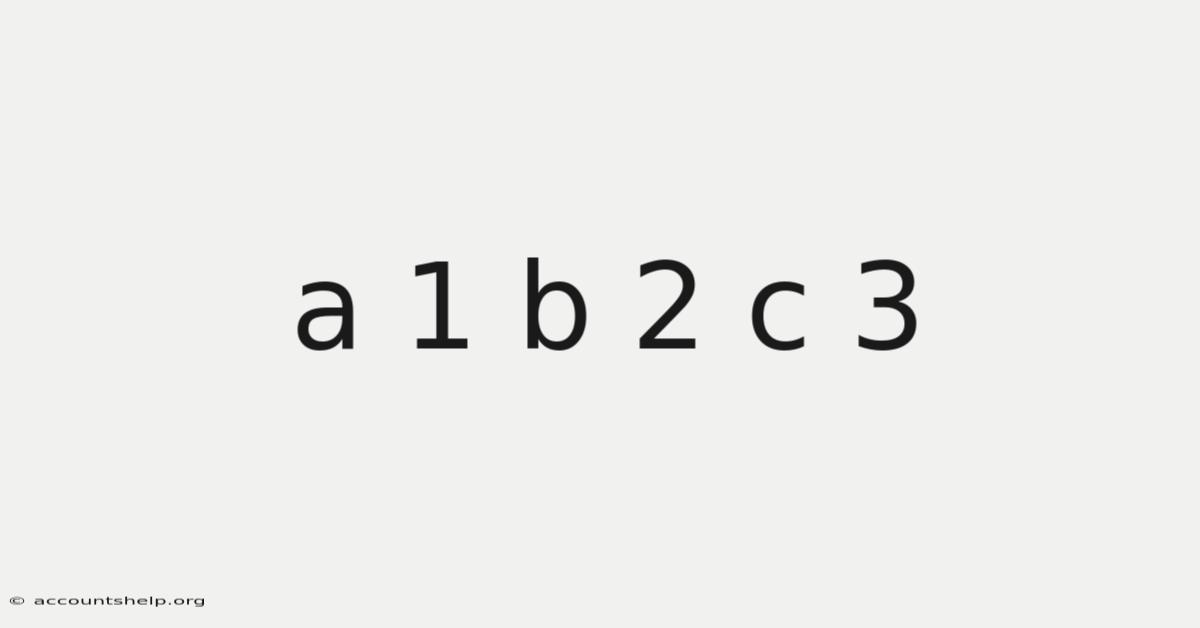
A 1 B 2 C 3
What Is a 1 B 2 C 3?
Most people encounter sequences like "a 1 b 2 c 3" in passing—on forms, in coding tutorials, or scribbled on a whiteboard during a math problem. Also, at its core, it's a simple alternating pattern: letters followed by numbers, each incrementing in lockstep. But don't let the surface simplicity fool you.
This pattern appears everywhere from programming loops to alphabet blocks for toddlers. It's the kind of thing you use without thinking, then forget about until you need it again.
The Pattern Breakdown
The sequence works like this:
- Position 1: letter 'a'
- Position 2: number '1'
- Position 3: letter 'b'
- Position 4: number '2'
- Position 5: letter 'c'
- Position 6: number '3'
And so on. Each pair advances both the letter (a→b→c) and the number (1→2→3) simultaneously. It's not random. It's not arbitrary. It's a deliberate, predictable progression that creates a rhythm.
Why People Care About This Pattern
You might wonder why anyone would write about something so seemingly basic. The answer lies in how often this pattern surfaces in practical applications.
In Programming and Coding
Developers use this kind of alternating sequence constantly. Think about generating test data, creating indexed arrays with meaningful labels, or building simple encryption schemes. The pattern provides a clean way to pair sequential elements without complex logic.
I've seen this in JavaScript functions that generate form fields, where each input needs both an ID and a label. The pattern emerges naturally when you're iterating through options and need to maintain both alphabetical and numerical references.
In Education and Learning
Teachers use variations of this pattern to help students grasp sequencing, counting, and alphabetical order simultaneously. It's particularly useful for kinesthetic learners who benefit from seeing multiple patterns reinforce each other.
The pattern also appears in early reading instruction, where children learn letter sounds alongside number recognition. It's not coincidental—many early education curricula use this dual-pattern approach.
How the Pattern Actually Works
Breaking it down reveals the underlying logic that makes it so versatile.
The Mathematical Foundation
At its heart, this pattern follows a simple mathematical rule: for any position n in the sequence, if n is odd, you get a letter; if n is even, you get a number. The specific letter comes from (n+1)/2 in the alphabet, while the number is simply n/2.
So position 7 gives you the 4th letter ('d') paired with the 3rd number ('3'). In real terms, position 8 gives you the 4th number ('4'). See how it builds?
Implementation in Different Contexts
In spreadsheet software, you might generate this with formulas that check row parity. In text editors, regex patterns can match and manipulate these sequences. Even in handwriting practice, the pattern helps develop muscle memory for both letter formation and number writing.
The real power isn't in the complexity—it's in the predictability. When you know the rules, you can generate as much of the sequence as you need, instantly.
Common Mistakes People Make
Even something this straightforward trips people up more often than you'd expect.
Assuming It's Always Simple
Many people treat this as a one-size-fits-all pattern. But variations exist everywhere. Sometimes it's a 1 b 2 c 3 d 4. Sometimes it's a 2 b 3 c 4. The starting point and increment can shift, creating entirely different sequences that follow similar logic.
I've seen beginners struggle because they memorized one version but couldn't adapt when the context changed slightly.
Overcomplicating the Logic
On the flip side, some people see this pattern and immediately think they need complex algorithms or advanced mathematics to work with it. The beauty of this sequence is its simplicity. You don't need a computer science degree to understand that a pairs with 1, b with 2, and so on.
The key is recognizing when to apply the pattern and when to move on to something more sophisticated.
Continue exploring with our guides on which of the following drugs is not a hallucinogen and how to find component form of vector.
Practical Applications That Actually Work
Here's where this pattern shines—when you put it to real use.
Data Structure Design
When organizing information that naturally comes in pairs—labels and values, categories and counts—this pattern provides a clean indexing system. I've used it in database design where each category needs both a short code and a sequential identifier.
User Interface Elements
Form builders, menu systems, and navigation structures often benefit from this kind of pairing. When you're creating numbered steps with lettered sub-steps, or lettered sections with numbered items, the pattern provides visual consistency that users can follow effortlessly.
Memory Aids and Mnemonics
At its core, where the pattern becomes genuinely helpful. Students use it to remember ordered information, professionals use it to keep track of sequential processes, and writers use it to maintain structure in complex documents.
The human brain is wired to recognize patterns. Give it something like a 1 b 2 c 3, and it latches onto the rhythm almost instantly.
FAQ
Is this just a random sequence, or is there a method to it?
There's definitely a method. Each letter corresponds to its position in the alphabet, and each number matches the letter's position divided by two (rounded up). It's not random—it's systematic.
Can this pattern be extended indefinitely?
Absolutely. You can continue it as long as you have letters and numbers. After z 26, you'd start over with aa 27, ab 28, or switch to a different numbering system entirely.
Where else might I encounter this pattern?
You'll see it in labeling systems (like chemical elements or musical scales), in coding exercises, in early childhood education materials, and in any situation where paired sequential data needs organizing.
Is there a specific term for this type of sequence?
Not really. In practice, it's just an alternating alphanumeric sequence. Sometimes people call it a "letter-number pair pattern" or similar descriptive phrases, but there's no formal mathematical term for it.
Final Thoughts
What started as a simple sequence—"a 1 b 2 c 3"—reveals itself as a fundamental building block for organizing information. It's not flashy. But it doesn't require advanced degrees to understand. But it's incredibly useful.
The pattern works because it taps into how we naturally process information: in pairs, in sequences, in predictable rhythms. Whether you're coding, teaching, or just trying to keep track of things, this simple alternating sequence has your back.
And that's the thing about basic patterns—they're basic for a reason. They work.
Broader Applications
Beyond personal organization, this pattern finds practical use in project management, where tasks might be labeled A-1, B-2, C-3 for easy reference. Now, it appears in inventory systems, academic outlining, and even in creative writing for chapter and scene numbering. The dual-coding system provides redundancy that reduces errors and speeds up retrieval.
In educational settings, teachers use variations of this pattern to help students remember sequences—from the order of operations in math to historical timelines. The alternating structure creates natural checkpoints that aid memory formation.
Adapting the Pattern
The beauty of this system lies in its flexibility. Also, you can modify it based on your needs: reverse the order to "1 a 2 b 3 c", use different character sets, or adjust the numerical progression. Some prefer starting with numbers, others with letters—the core principle remains the same.
For technical applications, programmers often implement this pattern using simple loops or iterators that generate paired sequences automatically, making it scalable for large datasets.
Final Thoughts
This simple alternating sequence demonstrates how basic patterns can solve complex organizational challenges. It bridges the gap between human cognition and systematic data management, offering a solution that's both intuitive and efficient.
Whether you're structuring a database, designing a user interface, or helping a child with homework, the "a 1 b 2 c 3" pattern provides a reliable framework for bringing order to information. Its strength lies not in complexity, but in its perfect alignment with how we naturally think and organize our world.
Latest Posts
What's New
-
Why Is Dna Replication Called Semi Conservative
Aug 17, 2026
-
Difference Between Latent Heat Of Vaporization And Fusion
Aug 17, 2026
-
Where Does The Light Independent Reaction Take Place
Aug 17, 2026
-
What Does Representative Mean In Math
Aug 17, 2026
-
Si Base Units And Derived Units
Aug 17, 2026
Related Posts
Topics That Connect
-
Which Is A Non Membrane Bound Organelle
Aug 01, 2026
-
How To Solve For Limiting Reagent
Aug 01, 2026
-
How Many Electrons In The F Orbital
Aug 01, 2026
-
Length Of Segment Of Circle Formula
Aug 01, 2026
-
What Type Of Tissue Is Avascular
Aug 01, 2026
