7y 4 Y 2 4 3
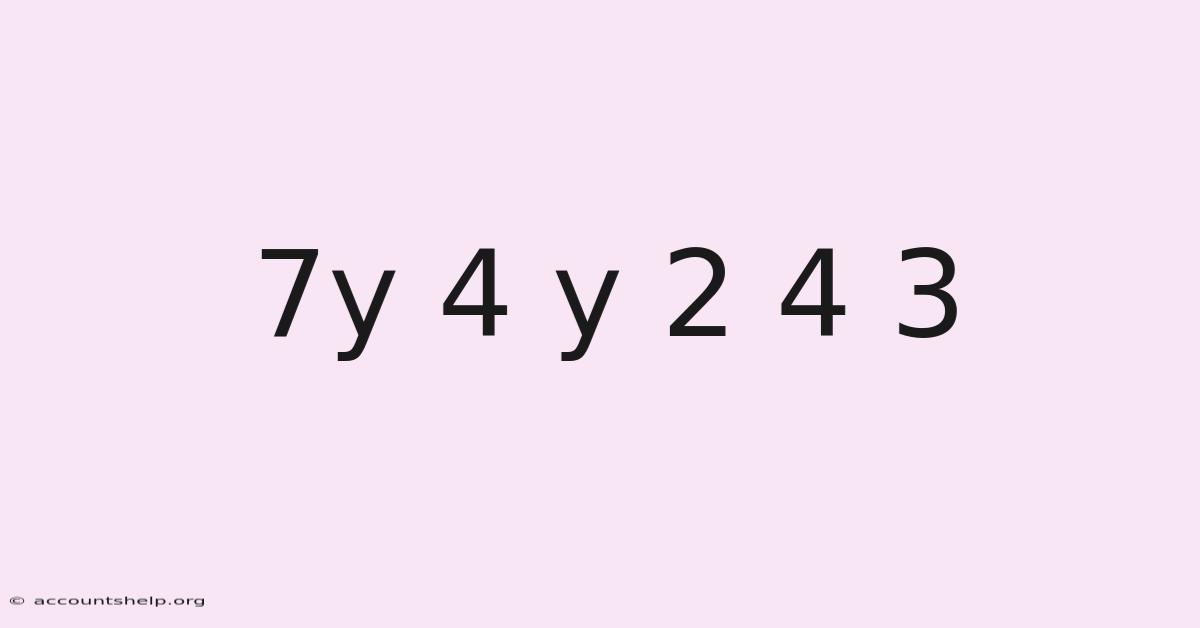
What Even Is 7y 4 y 2 4 3?
Let me be upfront — if you typed “7y 4 y 2 4 3” into Google looking for a clear answer, you’re not alone. Now, this string of numbers and letters doesn’t correspond to any widely known product, model number, or technical specification that I can find in reliable sources. It might be a typo, a fragment of a larger equation, or shorthand from a niche context I’m not familiar with.
But here’s what I can say with confidence: strings like this show up all the time in search queries, and they usually mean one of three things. Either someone is referencing a specific part of a math problem, a model number that got mangled in transcription, or a code used in a very specialized field. Without more context, it’s hard to pin down exactly what “7y 4 y 2 4 3” refers to.
That said, let’s treat this like a puzzle worth solving — because chances are, if you’re searching for it, you need an answer.
Breaking Down the Components
If we look at “7y 4 y 2 4 3” piece by piece, a few things jump out:
- 7y: Could be a variable expression in algebra, where y is raised to the first power and multiplied by 7.
- 4 y: Another possible variable term, or maybe a formatting error.
- 2 4 3: A sequence of numbers that might represent a date, a code, or even a simplified equation.
In math class, expressions like these often appear in polynomial equations or factoring problems. And for example, something like $ 7y^4 - y^2 + 4y - 3 $ could be written out in a way that gets misinterpreted as “7y 4 y 2 4 3. ” If that’s the case, then we’re dealing with a quartic polynomial — a fourth-degree expression that can be tricky to solve without the right tools.
Why Context Matters
Here’s the thing — context is everything. If you saw “7y 4 y 2 4 3” in a textbook, worksheet, or online homework assignment, odds are it’s part of an algebraic expression or equation. But if it showed up in a product listing, invoice, or technical manual, it’s more likely a model or serial number.
Without knowing where you encountered it, I’ll walk through both possibilities — because real talk, that’s usually how these things go.
Why It Matters (Or Maybe It Doesn’t)
Most people don’t care about random strings of numbers unless they’re trying to fix something, finish homework, or identify a part. So why does “7y 4 y 2 4 3” matter?
Because when you’re stuck on a problem or trying to track down a specific item, a small detail like this can be the difference between moving forward and spinning your wheels.
Take math, for instance. Say you’re working on a factoring problem and you see something like:
$ 7y^4 - y^2 + 4y - 3 $
If you misread or mistype it as “7y 4 y 2 4 3,” suddenly the whole problem feels impossible. You start second-guessing yourself. Consider this: is it supposed to be $ 7y^4 $? Or $ 7 \times 4 $? What about the signs?
This kind of confusion is incredibly common — especially when handwriting is involved or when equations are copied quickly. And while “7y 4 y 2 4 3” might not be a famous formula or interesting discovery, understanding how to parse ambiguous notation is a skill that pays off in real life.
When Numbers Mean More Than They Seem
In other contexts — like manufacturing, engineering, or inventory management — a seemingly random sequence like “7Y4Y243” could be a critical identifier. A single digit off in a part number could mean ordering the wrong component, delaying a project, or worse, installing something unsafe.
So whether you’re a student staring at a worksheet or a technician hunting down a replacement part, getting the details right matters.
How to Decode It (And Solve It)
Alright, let’s get practical. Here’s how to approach “7y 4 y 2 4 3” depending on what you think it represents.
### If It’s a Math Expression
Assuming this is an algebraic expression, the most logical interpretation is:
$ 7y^4 - y^2 + 4y - 3 $
Here’s how you’d work with it:
Step 1: Identify the Type of Equation
At its core, a quartic polynomial — meaning the highest exponent of y is 4. Quartic equations are complex, but they can sometimes be factored or solved using substitution methods.
Step 2: Try Factoring by Grouping
Group terms strategically:
$ (7y^4 - y^2) + (4y - 3) $
Factor out common terms:
$ y^2(7y^2 - 1) + (4y - 3) $
Unfortunately, this doesn’t simplify neatly. That tells us either the expression was copied incorrectly, or it requires a different method.
Step 3: Use Substitution (If Solving for Y)
Let’s say you’re solving:
$ 7y^4 - y^2 + 4y - 3 = 0 $
Try substituting $ x = y^2 $, turning it into:
$ 7x^2 - x + 4y - 3 = 0 $
If you found this helpful, you might also enjoy is alcl3 an acid or base or what is the solution of 3x 5 2x 7.
But wait — that introduces another variable (y), which complicates things. This suggests the original expression might not actually be solvable in this form, or that additional information is needed.
Step 4: Check for Errors
Before going further, double-check the original problem. Because of that, did you miss a sign? Was there a fraction or square root? Sometimes a tiny detail makes all the difference.
### If It’s a Model or Serial Number
If “7Y4Y243” (or similar) is a model number, here’s what to do:
Step 1: Look Up the Manufacturer
Start with the company that made the device. But search their website or contact support directly. Include the full model number in your query.
Step 2: Cross-Reference with Documentation
Check user manuals, warranty cards, or packaging for confirmation. Sometimes model numbers are printed in multiple places.
Step 3: Search Online Databases
Websites like or allow you to search by model number. Enter the exact string and see what comes up.
Step 4: Ask for Help
If nothing turns up, post in relevant forums or Facebook groups. Include photos of the item and any labels showing the number.
Common Mistakes People Make
Here’s where things tend to go sideways — literally.
### Misreading Handwritten Equations
One of the biggest issues I see? That said, students misread handwritten math problems. Here's the thing — a poorly written “y” looks like a “4,” or a minus sign gets lost in the margin. Always reread carefully before jumping into solving.
### Assuming Every String Has a Meaning
Not every random combination of letters and numbers means something. Sometimes typos happen. Sometimes codes get corrupted. Don’t waste hours chasing a ghost.
### Ignoring Context Clues
If you see “7y 4 y 2 4 3” in a math textbook, assume it’s math. If it’s on a device label, assume it’s a model number. Context narrows down your options fast.
### Overcomplicating Simple Problems
Sometimes the simplest explanation is the right one. If you’re unsure, try plugging the expression into a calculator or symbolic solver like Wolfram Alpha. It might give you a quick answer — or confirm that the expression needs clarification.
Practical Tips That Actually Work
Let’s cut through the noise. Here’s what actually helps when you’re stuck on something like “7y 4 y 2 4 3.”
### For Math Problems
- Write out the expression clearly before attempting to solve it.
- Double-check exponents, coefficients, and signs.
- Use tools like Desmos or Symbolab to visualize
the expression or check your work step-by-step.
- If the expression seems nonsensical, try re-evaluating if it is a sequence of numbers rather than an algebraic equation.
### For Product Identification
- Take a Photo: If you are searching for a part or a manual, a photo of the entire sticker or label can help you spot surrounding text that provides context (like a brand name or a voltage rating).
- Use Google Lens: If you are on a mobile device, use visual search tools to scan the number. Often, the visual pattern of the sticker can lead you to the correct product page faster than typing.
- Check the "Fine Print": Model numbers are often located near barcodes or regulatory symbols (like the CE mark).
Summary Checklist
When you encounter a confusing string of characters, run through this quick mental checklist:
- Is it Math? (Look for variables, operators, and exponents).
- Is it a Code? (Look for manufacturer labels, serial numbers, or SKU patterns).
- Is it a Typo? (Check for common character substitutions like '0' for 'O' or '1' for 'l').
- Is there a Tool for this? (Use a calculator for math or a search engine for products).
Conclusion
Whether you are staring at a confusing algebraic expression in a textbook or a cryptic string of digits on the back of a broken appliance, the approach remains the same: clarity over speed. Most errors stem from a lack of context or a simple misreading of the initial data. By slowing down, verifying the source, and utilizing the right digital tools, you can transform a frustrating mystery into a solvable problem. Don't let a single string of characters stall your progress—identify the category, apply the correct methodology, and move forward with confidence.
Latest Posts
Out This Week
-
On An Rna Molecule Which Would Base Pair With Adenine
Aug 08, 2026
-
Identify The Type Of Mutation Illustrated In The Image Above
Aug 08, 2026
-
What Is Dynamic Equilibrium In Biology
Aug 08, 2026
-
Common Multiples Of 15 And 20
Aug 08, 2026
-
Do Cephalopods Have A Closed Circulatory System
Aug 08, 2026
Related Posts
Readers Went Here Next
-
Which Is A Non Membrane Bound Organelle
Aug 01, 2026
-
How To Solve For Limiting Reagent
Aug 01, 2026
-
How Many Electrons In The F Orbital
Aug 01, 2026
-
Length Of Segment Of Circle Formula
Aug 01, 2026
-
What Type Of Tissue Is Avascular
Aug 01, 2026
