2x X 7 X 3 4
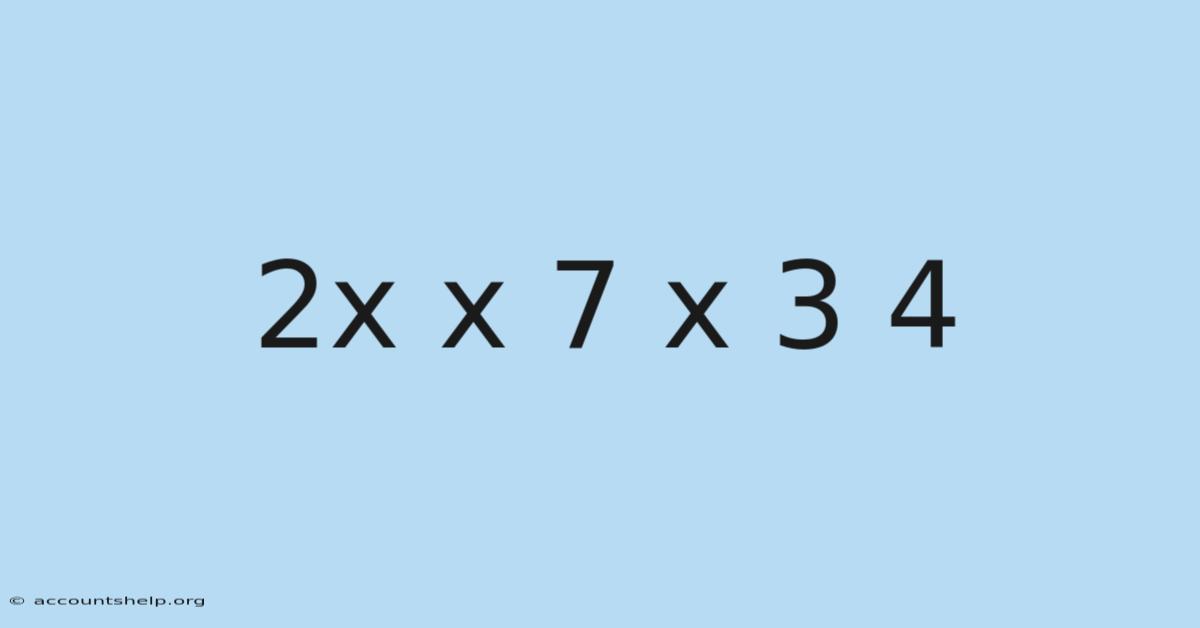
Ever stared at a string like 2x x 7 x 3 4 and wondered what on earth it means? Now, maybe you saw it scribbled on a notebook, or maybe a friend tossed it into a conversation and you nodded like you got it. The truth is, that jumble isn’t a secret code or a random scramble—it’s a straightforward multiplication expression that shows up more often than you’d think. In this post we’ll unpack what 2x x 7 x 3 4 actually is, why it matters, how to handle it without pulling your hair out, and what most people miss when they try to simplify it.
What Is 2x x 7 x 3 4
The Expression at a Glance
At first glance, 2x x 7 x 3 4 looks like a mash‑up of letters and numbers. The “2x” part tells you there’s a variable in play, while the rest are plain numbers. On top of that, when you line them up with multiplication signs, you have 2x multiplied by 7, then by 3, then by 4. In math lingo, that’s a product of four factors, one of which contains a variable.
Breaking Down Each Part
Let’s take it piece by piece. The “2x” means two times whatever x represents. It’s not a separate number; it’s a coefficient multiplied by a variable. The “7” is just seven, a constant. The “3” and “4” are also constants, each standing alone. When you multiply them all together, the constants get bundled, and the variable stays as x.
The Result
If you crank through the arithmetic, you’ll end up with 168x. That’s because 2 times 7 is 14, 14 times 3 is 42, and 42 times 4 is 168. So the whole thing collapses to 168 times x. Now, simple, right? But simplicity can hide pitfalls, and that’s where the next sections come in.
Why It Matters / Why People Care
In Math Class
Students often meet this kind of expression early on, and the ability to simplify it quickly sets the tone for later algebra. Getting it right means you can move on to solving equations, factoring, and graphing without constantly re‑doing the same multiplication steps.
In Real Life
Think about cooking. If a recipe calls for 2x cups of flour (maybe x is the number of batches you plan to make) and you need to multiply that by 7 for a big gathering, then by 3 for a triple batch, and finally by 4 for a quadruple batch, you’re essentially working with 2x x 7 x 3 4. Understanding how to collapse that into a single number helps you avoid over‑ or under‑buying ingredients.
In Programming
When you write a formula in code, you might see something like result = 2 * x * 7 * 3 * 4. If you don’t simplify, you could end up with unnecessary calculations, which in a tight loop might slow things down. Knowing that the product of the constants is 168 lets you rewrite the line as result = 168 * x, which is cleaner and potentially faster.
How It Works (or How to Do It)
Step 1: Identify the Terms
Start by spotting each factor. In 2x x 7 x 3 4, you have four items: 2x, 7, 3, and 4. Write them down if it helps, especially if the expression gets longer.
Step 2: Multiply the Constants
Grab the numbers and multiply them together, ignoring the variable for the moment. 2 (from the 2x) times 7 is 14. Then 14 times 3 gives 42. Still, finally, 42 times 4 equals 168. That’s your constant factor.
Step 3: Re‑attach the Variable
Now bring the x back into the picture. Since the constant you just calculated is multiplied by x, the final simplified form is 168x. No extra steps needed; you’ve just combined everything into one tidy term.
Step 4: Check Your Work
A quick sanity check can save you from a careless slip. That said, if x were 1, the original expression would be 2 * 1 * 7 * 3 * 4, which equals 168. Plugging 1 into 168x also gives 168, so the math checks out.
Example in Action
Imagine you’re planning a community event. You need 2x chairs for the main stage, where x is the number of groups expected. You decide to triple the seating for a special guest, then add three more groups, and finally want to quadruple the whole setup. But the total chairs become 2x * 7 * 3 * 4. Simplifying gives you 168x chairs. Practically speaking, if x is 5 groups, you’ll need 840 chairs. That’s a lot, but now you know exactly how the number comes together.
Want to learn more? We recommend are mitochondria found in animal cells explain and definition of law of constant composition for further reading.
Common Mistakes / What Most People Get Wrong
Forgetting the Order of Operations
Some folks treat the expression as if they need to solve for x first, which isn’t necessary. The order of operations tells you to multiply left to right, but because multiplication is associative, you can group the numbers any way you like. Still, if you start by isolating x, you’ll end up with unnecessary steps.
Misinterpreting “2x”
A common slip is thinking “2x” means something else, like “2 times x” versus “2x” as a separate term. In this case, it’s definitely two times the variable, so you treat the 2 as part of the constant factor.
Assuming the Result Is a Number
Because the expression contains a variable, the result isn’t a fixed number—it’s a term that still depends on x. If you walk away thinking you have a single number, you’ll miss the point entirely.
Rushing Through the Multiplication
It’s easy to glance at 2x x 7 x 3 4 and think “just multiply everything,” but skipping a step can lead to arithmetic errors. Taking a moment to multiply the constants separately keeps you honest.
Practical Tips / What Actually Works
Write It Out Step by Step
Instead of trying to do everything in your head, jot down each multiplication. Seeing 2 times 7 become 14, then 14 times 3 become 42, and finally 42 times 4 become 168 makes the process transparent.
Use Parentheses for Clarity
If you’re worried about confusion, rewrite the expression with parentheses: (2x) × 7 × 3 × 4. That visual cue reminds you that the variable stays attached to the 2, and the numbers multiply cleanly.
Double‑Check with a Calculator
Even if you’re confident in mental math, a quick calculator pass can catch a slip. Enter 2 * 7 * 3 * 4 and verify you get 168 before re‑attaching x.
Practice with Similar Problems
The more you work with expressions that mix variables and constants, the faster you’ll spot patterns. Try changing the numbers, or replace the variable with a different letter, and see how the constant part shifts.
FAQ
What does 2x x 7 x 3 4 equal?
It simplifies to 168x. The constants multiply to 168, and the variable x remains unchanged.
Can I solve for x without more information?
Not really. The expression is just a term; you need an equation—like 168x = 504—to find a concrete value for x.
Is this expression used in any specific field?
Absolutely. It shows up in algebra, physics (when scaling quantities), cooking calculations, budgeting spreadsheets, and even in certain programming formulas where you need to scale a variable by several factors.
How can I avoid mistakes when simplifying?
Take it slow, break the multiplication into small chunks, write each intermediate result, and always double‑check with a calculator or by plugging in a simple value for x.
Closing Thoughts
Understanding 2x x 7 x 3 4 isn’t about memorizing a rule; it’s about recognizing a pattern, breaking it down, and letting the math do the heavy lifting. That said, the next time you run into a similar jumble, you’ll have a clear path forward, and you’ll avoid the common pitfalls that trip up many. When you see a string of numbers and letters like this, treat it as a series of building blocks—multiply the constants, keep the variable intact, and you’ll end up with a clean, single term that tells you exactly what’s going on. That’s the real power of a little careful arithmetic.
Latest Posts
Dropped Recently
-
What Does A Acute Isosceles Triangle Look Like
Aug 25, 2026
-
Do Elements In The Same Period Have Similar Properties
Aug 25, 2026
-
State Of Matter At Room Temperature For Fluorine
Aug 25, 2026
-
A Set That Contains No Elements Is Called The
Aug 25, 2026
-
Is Kingdom Plantae Autotrophic Or Heterotrophic
Aug 25, 2026
Related Posts
Keep the Thread Going
-
Which Is A Non Membrane Bound Organelle
Aug 01, 2026
-
How To Solve For Limiting Reagent
Aug 01, 2026
-
How Many Electrons In The F Orbital
Aug 01, 2026
-
Length Of Segment Of Circle Formula
Aug 01, 2026
-
What Type Of Tissue Is Avascular
Aug 01, 2026
