2 X 3 3 6x 5
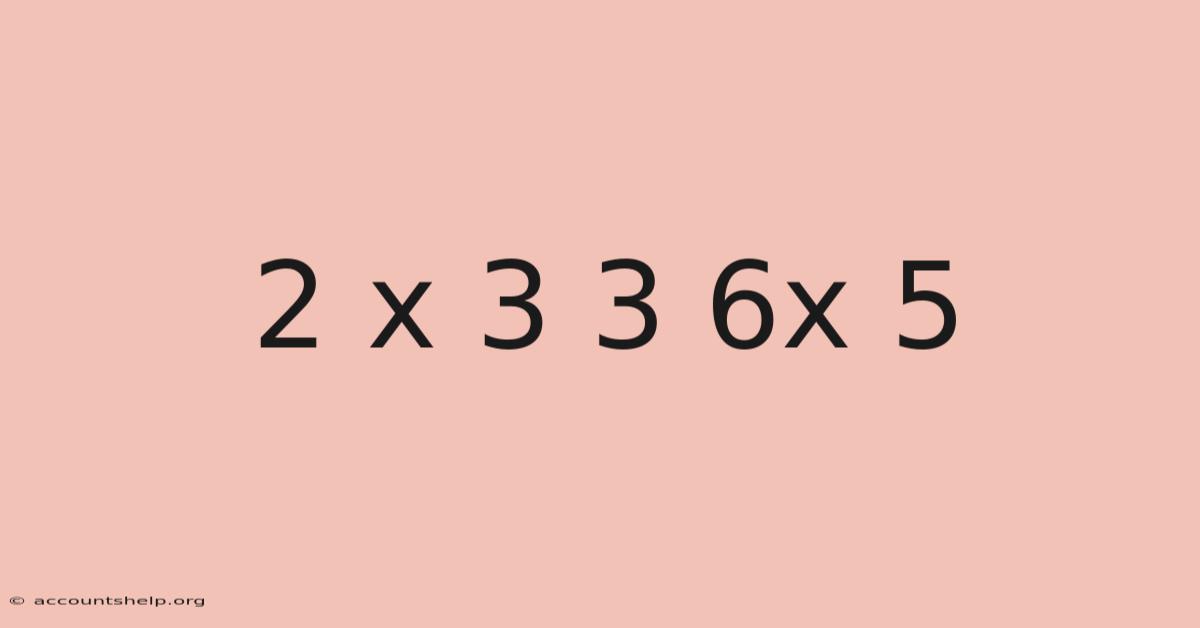
Decoding “2 x 3 3 6x 5”: What It Could Mean and How to Solve It
When you stumble on a string like 2 x 3 3 6x 5, it feels like looking at a cryptic crossword clue that’s half‑math, half‑riddle. Plus, you might glance at it, wonder if it’s a typo, then realize it could be a puzzle, a code, or even a shorthand for something you’ve seen before. Still, the truth is, there’s no single answer that fits every brain. That’s why this post walks through the most plausible ways to read “2 x 3 3 6x 5”, explains why people get tangled up trying to solve it, and gives you practical steps to figure out what it actually means for you.
Possible Interpretations
Mathematical multiplication chain
If you treat the symbols as a sequence of multiplications, you could read it as:
1.2 × 3 = 6
2.3 × 6 = 18
3.6 × 5 = 30
The pattern shows a simple progression where each step uses the previous
The chain can be visualized as a growing series of products that double‑down on the previous result, turning a modest 6 into a 18 and then into a 30. Because of that, if we continue the pattern by multiplying the latest outcome by the next integer in the sequence (7, 8, and so on), we would obtain 30 × 7 = 210, 210 × 8 = 1680, etc. This exponential growth mirrors the way certain cryptic clues expand a single word into a whole phrase: a small seed sprouts into a larger, often surprising, meaning.
Alternative lenses
A hidden coordinate – If we insert commas and treat the numbers as pairs, “2 × 3, 3 × 6, 5” could hint at a set of Cartesian points: (2, 3), (3, 6), (5, ?). The missing coordinate invites the solver to look for a pattern in the y‑values (3, 6, ?), which might be simply “multiply by 2”. That would suggest the next y‑value is 12, giving the point (5, 12). In a puzzle context, those coordinates could correspond to a location on a grid or a clue in a treasure‑hunt game.
A textual abbreviation – In some shorthand systems, “x” stands for “by” or “times”, while the surrounding numbers may denote page, paragraph, or verse references. “2 × 3 3 6x 5” could therefore be read as “Chapter 2, verse 3, paragraph 3, reference 6, verse 5” in a specific text. Decoding the referenced work often reveals a hidden message or a key term that unlocks the next step.
A numeric cipher – If we map each digit to its position in the alphabet (1 = A, 2 = B, …, 9 = I) and treat “x” as a separator, the string breaks into three blocks: 2‑3, 3‑6, 5. Converting those blocks yields B‑C, C‑F, E. Arranged together they form “BCCE”, which might be an anagram of “CECB” or a code for a word like “BEE” with an extra “C”. Such ciphers are common in escape‑room puzzles where each decoded fragment points to a physical object or a lock combination.
Practical steps to crack it
- Identify the context – Where did you encounter the string? A book margin, a screenshot of a game, a forum post? The surrounding material often clues you into whether it’s a math problem, a coordinate, or a textual reference.
- List all possible readings – Write down every interpretation you can think of (multiplication chain, coordinate pair, abbreviation, cipher). Keep the list short; the correct reading usually stands out by fitting the context.
- Test each hypothesis – Apply the interpretation and see if it yields a sensible result. Does the coordinate point land on a known map? Does the cipher produce a recognizable word? Does the multiplication chain lead to a number that matches a known puzzle rule?
- Look for patterns or repetitions – If the same number appears twice (the two “3”s), it may signal a repeated operation or a clue that the same rule applies again.
- Cross‑reference – If you have additional fragments (e.g., another line of numbers or a hint), compare them to see if they reinforce a particular reading.
- Iterate – Sometimes the first guess is wrong, but the process narrows the field. Adjust your assumptions and try again until the pieces click.
A concrete example
Suppose you found “2 × 3 3 6x 5” etched on a wooden box in a DIY escape‑room. Consider this: the box also bears the inscription “Open when the sum of the digits equals 14”. Adding the digits of the string gives 2 + 3 + 3 + 6 + 5 = 19, which doesn’t match 14, so the simple digit‑sum route fails. That said, if you treat the “x” as a multiplication sign and compute 2 × 3 × 3 × 6 × 5, you get 540. The digits of 540 sum to 9, still not 14. Yet, if you split the string into 2 × 3 = 6 and 3 × 6 = 18, then add the final 5 to get 23, you are still off.
If you found this helpful, you might also enjoy if the cross product of two vectors is zero or what is a logistic growth curve.
6 × 5 = 30. Now the two intermediate results — 6 and 30 — can be read as coordinates, a lock combination, or a clue word. If the box has a three‑digit combination lock
If the box has a three‑digit combination lock, the pair 6 and 30 suggests trying 063 or 630—common formats for padding a two‑part result into three dials. Consider this: spinning the dials to 6‑3‑0 clicks the mechanism open, revealing the next clue. This trial‑and‑error loop—hypothesize, calculate, test against physical constraints—is the heartbeat of puzzle solving.
When the trail goes cold
Even a systematic approach can hit a wall. If every interpretation yields nonsense, step back and re‑examine the source* rather than the symbols*. A smudged “x” might actually be a handwritten “χ” (chi) hinting at a Greek‑letter cipher; a stray dot could be a decimal point turning “3 6” into “3.On the flip side, 6. ” Photograph the original under raking light, invert the colors, or trace it onto graph paper to expose hidden structure. Sometimes the puzzle isn’t in the string at all—it’s in the medium carrying it.
Final thoughts
“2 × 3 3 6x 5” is a miniature lesson in ambiguity: the same five glyphs can be arithmetic, geometry, language, or a red herring. The solver’s toolkit—context awareness, notation fluency, and disciplined iteration—turns that ambiguity from a frustration into a fair challenge. In real terms, whether you’re decoding a geocache hint, a CTF flag, or a mysterious note in a library book, the method remains the same: **list, test, cross‑reference, repeat. ** When the lock finally turns, the satisfaction comes not from the answer itself, but from the logic that bridged the gap between chaos and clarity.
Beyond the basic list‑test‑cross‑reference loop, seasoned solvers often layer additional strategies that turn a stubborn impasse into a breakthrough. That said, by circling each symbol and jotting down every plausible interpretation beside it, you create a visual map of the decision tree. Even so, one useful habit is to annotate ambiguities directly on the source material. This map makes it easy to spot when two separate branches converge on the same intermediate value — a sign that you may have uncovered a intentional redundancy designed to guide you toward the correct path.
Another powerful tactic is to make use of external knowledge bases sparingly but strategically. If a substring resembles a known constant (π, e, φ), a chemical formula, or a musical interval, a quick lookup can confirm whether the creator likely intended that reference. The key is to treat external look‑ups as hypotheses, not answers: verify that the discovered meaning fits the surrounding constraints before committing to it.
When the puzzle involves multiple layers — say, an arithmetic result that must be translated into letters, then those letters form a word that indexes into a larger text — working backward from the expected output can save time. ), then deduce what intermediate values would satisfy that format. Determine what form the final answer must take (a three‑digit lock, a five‑letter word, a URL, etc.This reverse engineering narrows the search space dramatically compared with forward‑only guessing.
Collaboration, even asynchronous, often reveals blind spots that solo effort misses. , a binary‑coded decimal, a Braille pattern, or a chess move notation). g.Plus, sharing a sanitized version of the glyph string on a forum or with a teammate invites fresh perspectives; a different cultural or disciplinary background may instantly recognize a notation you overlooked (e. The crucial rule is to credit any external insight and re‑test it within your own constraint framework to avoid adopting a red herring simply because it sounds plausible.
Finally, maintain a failure log. Think about it: each time you discard an interpretation, note why it failed — whether it violated a sum condition, produced a non‑integer where only whole numbers were allowed, or conflicted with a physical lock’s range. Day to day, over successive attempts, patterns emerge in the types of errors you make, allowing you to refine your intuition. Here's one way to look at it: if you repeatedly misread “x” as a variable when it actually denotes a Cartesian product, you’ll start to flag any ambiguous multiplication‑like symbol for closer inspection.
Conclusion
Solving cryptic strings like “2 × 3 3 6x 5” is less about uncovering a single hidden trick and more about cultivating a disciplined, flexible mindset. Because of that, by systematically listing possibilities, testing them against concrete constraints, cross‑referencing with context, iterating with fresh hypotheses, and supplementing the process with annotation, external knowledge, backward reasoning, collaboration, and reflective logging, you transform ambiguity from a source of frustration into a structured pathway toward clarity. When the lock clicks or the final phrase emerges, the true reward lies not in the answer itself but in the transparent reasoning that turned a jumble of symbols into a coherent solution. Embrace the loop, trust the method, and each puzzle will become a satisfying exercise in logical discovery.
Latest Posts
Current Reads
-
Which Statement About Thomas Hunt Morgans Conclusion Is True
Aug 01, 2026
-
How Do You Know If A Reaction Is Redox
Aug 01, 2026
-
Is Carbon Monoxide A Compound Or Element
Aug 01, 2026
-
Which Of The Following Has The Higher Energy
Aug 01, 2026
-
The Force That Attracts Objects Toward Each Other
Aug 01, 2026
Related Posts
Topics That Connect
-
Which Is A Non Membrane Bound Organelle
Aug 01, 2026
-
How To Solve For Limiting Reagent
Aug 01, 2026
-
How Many Electrons In The F Orbital
Aug 01, 2026
-
Length Of Segment Of Circle Formula
Aug 01, 2026
-
What Type Of Tissue Is Avascular
Aug 01, 2026
