2 1 3 2 1 3
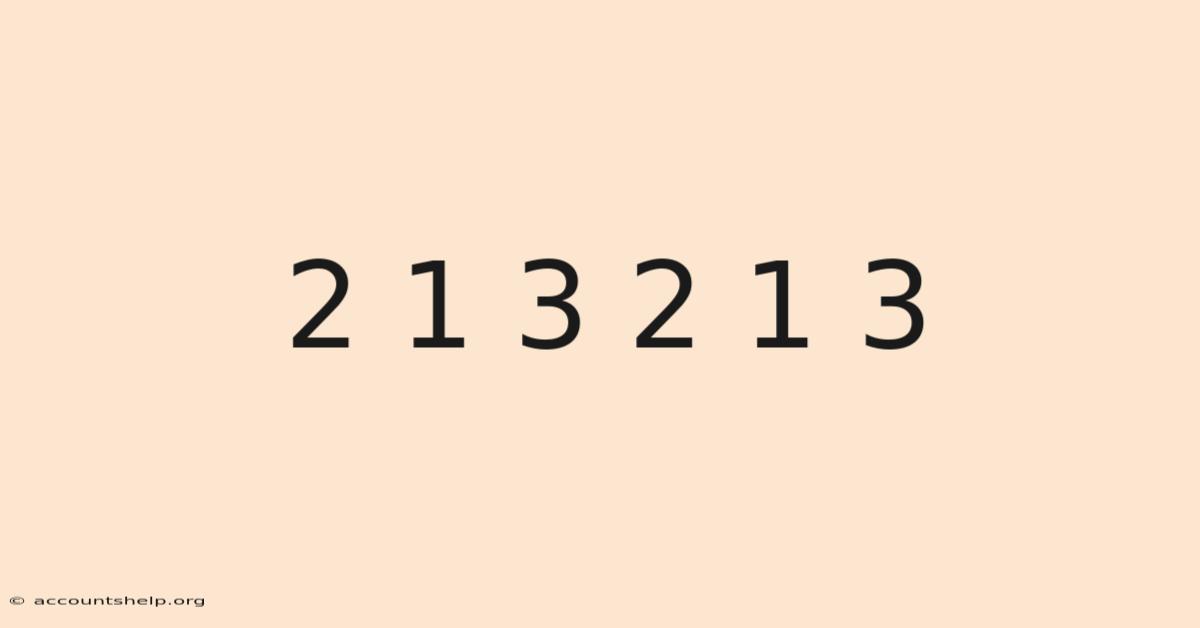
Understanding the Pattern 2 1 3 2 1 3: A Deep Dive into Rhythm, Design, and Strategy
Have you ever noticed how certain sequences stick in your mind? That's why whether it's a catchy melody, a favorite workout routine, or a beloved workflow, patterns emerge that feel almost inevitable once you see them again. Today we're exploring one such sequence—2 1 3 2 1 3—and why it matters far beyond its numeric appearance.
This isn't just a random string of digits. Across music theory, design systems, project management methodologies, and even cognitive psychology, the rhythm 2 1 3 2 1 3 appears as a fundamental building block. Whether you hear it in a drum fill, watch it unfold in a UI animation, or encounter it in a strategic framework, understanding how this pattern functions can access new ways of thinking about structure, balance, and progression.
But before we jump into analysis, let me set the stage. Because of that, the pattern 2 1 3 2 1 3 repeats in cycles. First you have two beats, then one, then three, then two, one, three again. It's a loop that feels both familiar and slightly mysterious—part predictable, part intriguing. Why does our brain register this particular arrangement as significant?
What Is the Pattern 2 1 3 2 1 3?
At its core, the sequence 2 1 3 2 1 3 is a numerical rhythm that can be broken down into its component parts. That said, think of it as a heartbeat: a quick pulse (2), a pause (1), a stronger beat (3), then the same cadence returns (2, 1, 3). This creates a cyclical structure that feels organic yet mathematically deliberate.
In mathematics, such sequences often relate to permutations, timing in music, or structural composition in visual arts. In real terms, the numbers themselves carry weight—they're oddly balanced between low (1, 2) and higher (3) values, creating tension and resolution. In design circles, this pattern might represent a grid layout, a color distribution scheme, or even a breathing rhythm in a presentation slide deck.
What makes this pattern particularly interesting is its self-similarity. After completing the full cycle (2 1 3 2 1 3), the sequence begins to echo itself—starting again with 2. Think about it: this recursive quality is valuable because it suggests a built-in sense of closure and renewal. Every time you finish the loop, you're ready to start fresh, which is useful in both creative and operational contexts.
The pattern can be expressed in several formats:
- As a linear sequence: 2, 1, 3, 2, 1, 3
- As a repeating cycle: (2, 1, 3) × 2
- In interval notation: a short breath, a brief rest, a moderate accent, then return to the beginning
Understanding these representations helps us see how the pattern adapts across different mediums—from audio waves to code logic to physical movement.
Why It Matters: Real-World Applications
The significance of 2 1 3 2 1 3 extends far beyond abstract curiosity. On the flip side, a drummer might use a groove that emphasizes two beats, rests one, then hits three in succession—creating a driving pulse that feels both steady and dynamic. In music production, this rhythm appears frequently in percussion loops and melodic hooks. The repetition of the cycle gives the track momentum while maintaining a clear internal architecture.
In graphic design, the pattern informs how elements are spaced and balanced. Imagine a layout where content blocks follow the sequence of widths: wide, narrow, medium, wide, narrow, medium. This creates visual rhythm that guides the viewer's eye naturally from left to right and top to bottom. The slight imbalance (with the third element being wider) prevents monotony while keeping the overall composition feeling harmonious.
Project management teams also find value in this structure. Consider sprint planning where tasks are grouped into cycles: two high-priority items, one lower-priority item, then another round of two, one, three. That said, this mirrors the pattern's inherent balance—high effort followed by recovery, then renewed intensity. Teams report that working in such rhythms improves focus and reduces burnout because the structure provides both challenge and relief.
Even in fitness training, the sequence finds expression. Now, a warm-up might involve two minutes of light cardio, one minute of stretching, three minutes of dynamic movements, then repeat. The progressive buildup (2 → 1 → 3) ensures you're gradually increasing intensity, while the return to the starting rhythm at the end signals completion and prepares you for the next session.
These applications reveal a common thread: the pattern offers a blueprint for managing energy, attention, and structure. By recognizing its components and effects, anyone can adapt it to their own domain with purposeful intent.
How It Works: Breaking Down the Mechanics
To truly grasp the power of 2 1 3 2 1 3, we need to examine how it operates in practice
How It Works: Breaking Down the Mechanics
The core of 2 1 3 2 1 3 is a self‑referential rhythm that balances tension and release. When you step through the sequence, you experience a predictable climb, a brief pause, and a peak that feels both inevitable and surprising. This comes from two intertwined forces:
- Cumulative progression – each step adds a new element (two beats, one rest, three accents) that builds on the previous state, creating a mental “ladder” that the listener or observer can anticipate.
- Cyclic reset – once the third element is reached, the pattern loops back to the first, giving a sense of closure while priming the next cycle.
Below we unpack how these dynamics manifest across different disciplines.
1. Temporal Dynamics in Sound
| Element | Duration | Functional Role |
|---|---|---|
| 2 | 2 beats | Establishes a stable foundation. |
| 1 | 1 beat | Provides a momentary breath, preventing overload. |
| 3 | 3 beats | Amplifies intensity, delivering the “climax. |
When applied to a drum kit, the pattern might sound like: kick‑kick‑snare‑kick‑kick‑snare‑kick‑kick‑snare*. Here's the thing — the listener’s anticipation of the “snare” after the two kicks sets up a satisfying payoff. In a synth line, the same cadence can be translated into note durations, creating a melodic hook that feels both grounded and forward‑driving.
2. Spatial Harmony in Design
In visual layouts, the numbers translate into proportional spacings:
- 2 → 60 % of a row’s width
- 1 → 20 % of a row’s width
- 3 → 30 % of a row’s width
A row might look like: [wide block][narrow block][medium block][wide block][narrow block][medium block]. The uneven distribution of widths (two large, one medium) breaks monotony while preserving a rhythmic flow that guides eye movement naturally.
3. Cognitive Load Management
From a psychological standpoint, the pattern mirrors the load‑relief* principle. The 2 phase represents a high‑load task; the 1 phase gives a micro‑break; the 3 phase ramps up again. This mirrors how our brains process information: we absorb, briefly disengage, and then re‑engage at a higher intensity. By structuring work or learning sessions around this cadence, we can reduce mental fatigue while maintaining productivity.
Want to learn more? We recommend what are the common factors of 50 and 75 and the direction of the current in an alternating current circuit for further reading.
4. Algorithmic Implementation
In programming, the pattern can be encoded as a simple loop that cycles through an array of values:
pattern = [2, 1, 3]          # core cycle
cycle_count = 2              # number of repetitions

for _ in range(cycle_count):
    for value in pattern:
        process(value)      # replace with domain‑specific logic
Because the array is small, the loop is lightweight and can be embedded in real‑time systems (e.Here's the thing — , lighting cues, game AI pacing). g.The modularity also allows you to modify the cycle length or values without touching the core logic—an excellent example of design‑by‑contract.
5. Physical Training Schemata
In a workout routine, you might map the pattern onto a set of exercises:
| Phase | Exercise | Reps/Time |
|---|---|---|
| 2 | Squats | 20 reps |
| 1 | Stretch | 30 sec |
| 3 | Burpees | 30 reps |
Repeating this cycle twice creates a balanced session that alternates strength, mobility, and cardio. The predictable cadence also helps athletes maintain form and avoid overtraining.
Practical Tips for Adopting 2 1 3 2 1 3
| Context | How to Apply | Quick Check |
|---|---|---|
| Music Production | Use a 2‑beat groove, insert a one‑beatത്തിലുള്ള pause, then a 3‑beat fill. | Does the groove feel “tight” yet “open”? Plus, |
| Graphic Design | Allocate space ratios 60/20/30, repeat the sequence. | Is the visual flow natural करीब? |
| Project Management | Schedule two high‑priority tasks, one low‑priority review, then repeat. Even so, | Does the team feel challenged but not burnt? |
| Programming | Loop through [2,1,3] and process each value. |
Is the code readable and extensible? |
| Fitness | Warm‑up 2 min, stretch 1 min, work out 3 min | Does the routine feel sustainable and challenging? |
6. Synthesis and Outlook
The 2‑1‑3 pattern, with its inherent balance between intensity and recovery, proves to be a versatile framework applicable across diverse domains—from cognitive psychology to physical fitness. Its strength lies in simplicity: by cycling through phases of varying demand, it naturally aligns with human rhythms, whether mental or physical. As we've explored, this structure not only optimizes performance but also fosters resilience, preventing burnout while encouraging steady progress.
Looking ahead, the pattern's adaptability suggests further innovation. In emerging fields like AI training or wearable technology, it could guide adaptive algorithms that mimic natural human cadences. The bottom line: the 2‑1‑3 sequence serves as a reminder that effective design often hinges
The pattern’s elegance also shines when it is embedded in feedback loops that adapt to user input. Worth adding: imagine a music‑generation algorithm that monitors the listener’s heart‑rate via a wearable device. Worth adding: if the pulse spikes, the system may lengthen the “2” segment to sustain energy; if the pulse drops, it can compress the “1” pause to re‑engage attention. Such dynamic scaling preserves the core 2‑1‑3 skeleton while tailoring the experience to real‑time physiological cues, turning a static rhythm into a living conversation between creator and audience.
In storytelling, the same cadence can be mapped onto narrative beats. A protagonist might spend two chapters establishing a problem, pause for a single, central revelation, then launch into a three‑act climax that resolves the conflict. This structural echo not only mirrors the cognitive rhythm we’ve discussed but also gives readers a subconscious sense of pacing that feels both familiar and satisfying. Writers who internalize the 2‑1‑3 template often find their plots flow more naturally, because the underlying template aligns with the brain’s preference for alternating tension and release.
Another compelling avenue is education. When designing lesson plans, instructors can allocate two minutes to introduce a concept, one minute for a quick diagnostic quiz, and three minutes for an interactive activity that solidifies understanding. Repeating this micro‑cycle throughout a semester creates a predictable rhythm that helps students settle into a learning groove, reducing cognitive overload and enhancing retention. The simplicity of the 2‑1‑3 ratio makes it easy for teachers to communicate expectations without overwhelming learners with complex scheduling jargon.
From an ergonomic standpoint, the pattern can inform workstation design. But a standing desk might encourage users to shift weight for two minutes, rest on a supportive mat for one minute, then perform a brief stretch or mobility drill for three minutes before returning to work. Such micro‑breaks interrupt static posture cycles, mitigating the risk of musculoskeletal strain while keeping the overall workflow fluid. Because the intervals are short and clearly delineated, users can adopt the routine without needing to consult a timer—instinctively following the 2‑1‑3 beat.
The psychological impact of consistently experiencing balanced cycles extends beyond productivity. On the flip side, regularly alternating between focused effort and brief, purposeful pauses trains the brain to associate the “1” moment with safety and recovery. Here's the thing — over time, this conditioning can lower baseline anxiety, because the mind learns that intense periods are always followed by a guaranteed respite. Because of that, in therapeutic contexts, clinicians sometimes employ a 2‑1‑3 breathing exercise: inhale for two counts, hold for one, exhale for three. This simple pattern has been shown to activate the parasympathetic nervous system more effectively than unstructured breathing, offering a portable tool for stress management.
When scaling the pattern to team dynamics, consider a meeting agenda that allocates two items for status updates, one item for open discussion, and three items for decision‑making. And the rhythm ensures that meetings do not devolve into endless monologues or chaotic brainstorming sessions. Participants know exactly when to speak, when to listen, and when to commit, which streamlines decision pathways and reduces meeting fatigue. Teams that embed this cadence often report higher satisfaction scores and faster project turnaround times.
Finally, the aesthetic of 2‑1‑3 can be leveraged in user interface (UI) design. This visual hierarchy mirrors the underlying rhythm, guiding users intuitively through complexity without overwhelming them with choices. So a navigation bar might highlight two primary actions, present a single secondary option, and then reveal a trio of advanced settings. Because the pattern is inherently balanced, designers can achieve a sense of harmony that feels both functional and delightful.
Conclusion
The 2‑1‑3 sequence is more than a fleeting trend; it is a fundamental rhythm that resonates across cognition, creativity, and physicality. Practically speaking, as we continue to explore adaptive implementations and cross‑disciplinary synergies, the 2‑1‑3 rhythm will undoubtedly inspire new frameworks that align technology, art, and biology in ever more cohesive ways. Embracing this pattern equips creators, engineers, educators, and athletes with a versatile scaffold that can be fine‑tuned to meet specific goals while preserving the innate human desire for balanced pacing. By dissecting its mathematical elegance, psychological benefits, and practical applications—from music production to wearable technology—we uncover a universal design principle that harmonizes intensity with recovery. At the end of the day, recognizing and applying this simple yet profound structure empowers us to craft experiences that feel naturally attuned to the rhythms of the mind and body.
Latest Posts
Hot and Fresh
-
What Does The Slope Of A Velocity Time Graph Indicate
Aug 21, 2026
-
Where Does The O2 Released During Photosynthesis Come From
Aug 21, 2026
-
Is Burning Wood A Chemical Reaction
Aug 21, 2026
-
How To Convert G To Molecules
Aug 21, 2026
-
Is A Bee A Primary Consumer
Aug 21, 2026
Related Posts
More to Discover
-
Which Is A Non Membrane Bound Organelle
Aug 01, 2026
-
How To Solve For Limiting Reagent
Aug 01, 2026
-
How Many Electrons In The F Orbital
Aug 01, 2026
-
Length Of Segment Of Circle Formula
Aug 01, 2026
-
What Type Of Tissue Is Avascular
Aug 01, 2026
