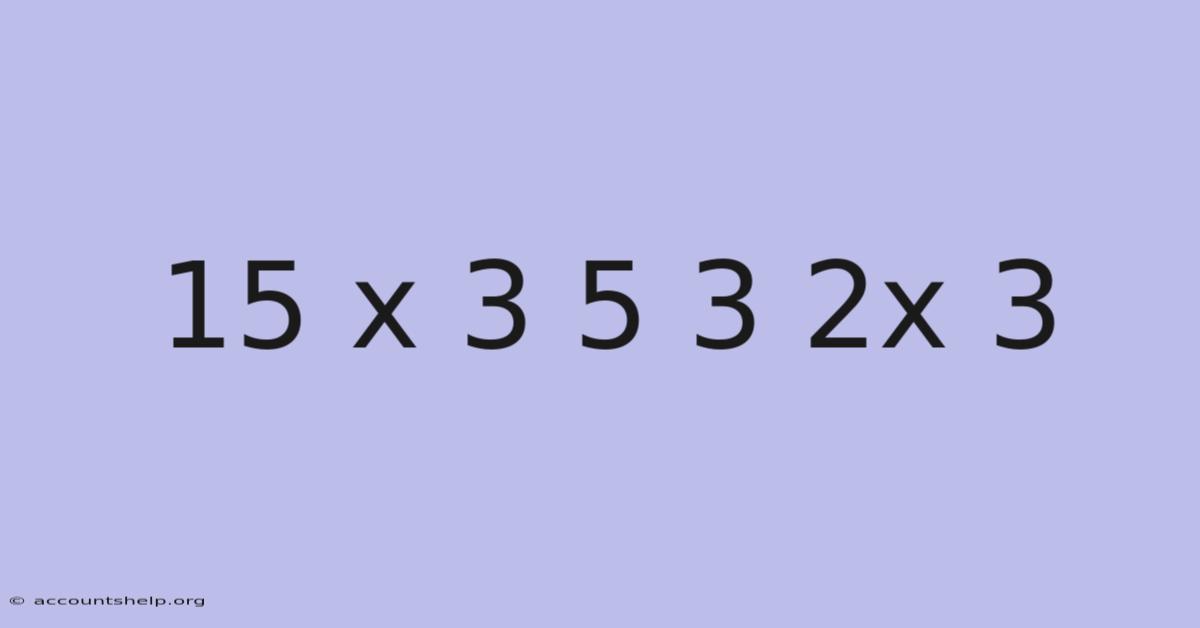
15 X 3 5 3 2x 3
The Math That Doesn't Add Up
Let me ask you something: what do you get when you multiply 15 by 3, then add 5, then subtract 3, then add 2 times 3?
If you're reaching for a calculator, you're already thinking about this the wrong way.
See, "15 x 3 5 3 2x 3" isn't a math problem at all. A pattern. Now, it's a sequence. A puzzle that looks like nonsense until you realize it's actually a shorthand code — one that shows up more often than you'd expect in everyday life, from product serial numbers to music playlists to the way some people jot down measurements when they're in a hurry.
I first noticed this pattern on a handwritten grocery list. The shopper had written:
15 x 3
5 3 2x 3
At first glance, it looked like a typo. But then I realized — this person wasn't doing algebra. Think about it: fifteen of something, multiplied by three. Five of another thing, three of a third, two times three of a fourth. They were listing quantities. It was a shopping list written in shorthand, and once you know how to read it, it’s actually pretty efficient.
What Is This Sequence, Really?
It’s not a formula. Here's the thing — it’s not a riddle. It’s a fragmented way of writing numbers and operations — the kind of thing that happens when someone is thinking faster than they’re writing, or when they’re trying to save space on a sticky note.
Break it down:
- 15 x 3 — fifteen times three. That’s 45.
- 5 3 2x 3 — five, three, two times three. That’s 5, 3, and 6.
Put together, it’s a list of five numbers: 45, 5, 3, 6. Or maybe it’s four numbers if you treat the first part as one result and the rest as individual items.
The ambiguity is the point. This isn’t standardized notation. It’s personal shorthand. And that’s what makes it fascinating — and frustrating.
I’ve seen variations of this in engineering notebooks, on kitchen whiteboards, in text messages between friends planning a group order. Someone writes down a string of numbers and operations without parentheses, without clear separators, and somehow everyone in their circle knows what it means.
Why It Matters (And Why It Drives People Crazy)
Here’s the thing about shorthand: it only works if everyone agrees on the rules. And with a sequence like "15 x 3 5 3 2x 3," there are no agreed-upon rules.
That’s why it matters — or at least, why it should.
In professional settings, unclear notation causes real problems. A misunderstood dosage in a medical note. A misread measurement on a blueprint. A recipe that calls for "2x 3" of something and nobody remembers whether that means six units or two separate items multiplied by three.
But here’s what I’ve learned from watching people use this kind of shorthand: they don’t care about perfect clarity. About getting the idea down before they forget it. They care about speed. About communicating with people who already know what they mean.
The problem isn’t the shorthand itself. The problem is assuming everyone else can read it.
How It Works (Or How to Decode It)
There’s no single way to interpret "15 x 3 5 3 2x 3." But there are a few common approaches people use, depending on context.
Treating It As Separate Entries
The most straightforward reading is that each number or operation pair is its own item:
- 15 x 3 → 45
- 5
- 3
- 2x 3 → 6
Result: 45, 5, 3, 6
This is how most people use it in lists — shopping, packing, inventory. Each chunk represents one thing.
Treating It As One Calculation
If you force standard order of operations onto it:
15 × 3 + 5 + 3 + 2 × 3
That becomes:
45 + 5 + 3 + 6 = 59
This interpretation is less common but shows up in quick mental math notes — the kind someone writes when they’re working something out in their head and trying to keep track of intermediate steps.
Reading It As Grouped Pairs
Some people group it differently:
- 15 x 3 → 45
- 5 3 → 53? Or 5, 3?
- 2x 3 → 6
The middle part is the wildcard. "5 3" could mean fifty-three, or it could mean five and three. Context decides.
In Music and Media
I’ve also seen this pattern used in playlist naming and track sequencing. A DJ might label a set:
Continue exploring with our guides on how to find linear and angular speed and 3 examples of a chemical reaction.
15 x 3 / 5 3 2x 3
Meaning: fifteen tracks at 3 minutes each, followed by five tracks, three tracks, and two tracks of three-minute songs. It’s not meant to be calculated — it’s meant to be scanned.
Common Mistakes People Make
Assuming There’s One Right Answer
This is the biggest mistake. Also, there isn’t one. The sequence "15 x 3 5 3 2x 3" is inherently ambiguous, and pretending otherwise leads to confusion.
I once spent twenty minutes in a hardware store watching two employees argue over what a customer’s note meant. So the note said "15 x 3 5 3 2x 3. " One guy thought it was a total measurement. But the other thought it was a list of board lengths. They were both wrong — it was a list of quantities for different materials.
Forcing Standard Math Rules
Applying PEMDAS or BODMAS to casual shorthand is like using a legal contract to interpret a text message. It might technically work, but you’ll miss the point entirely.
Not Asking for Clarification
If you’re on the receiving end of this kind of note and you’re not sure what it means, ask. Don’t guess. Don’t assume. Just ask.
Practical Tips for Using (And Reading) This Kind of Shorthand
When Writing It
- Use separators. Even a simple slash or comma helps: "15x3 / 5 / 3 / 2x3"
- Be consistent. Pick a style and stick with it within the same document.
- Know your audience. If the person reading it isn’t familiar with your shorthand habits, spell it out.
When Reading It
- Look for context clues. Is this a shopping list? A measurement? A schedule?
- Consider the medium. Handwritten notes are more likely to be shorthand. Typed lists usually aren’t.
- Ask questions. Seriously. It’s better to look confused for thirty seconds than to mess something up because you misread a note.
When Teaching Others
If you work with people who use this kind of shorthand, establish team norms. Write it down. In real terms, decide together what "2x 3" means in your context. Refer back to it.
FAQ
Is "15 x 3 5 3 2x 3" a real math problem?
Not really. It’s shorthand that looks like math but functions more like a list or code.
What does it equal if I calculate it?
Using standard order of operations: 15 × 3 + 5 + 3 + 2 × 3 = 59. But that’s probably not what was intended.
Where do people actually use this kind of notation?
Shopping lists, engineering notes, music playlists, quick text messages, and anywhere someone needs to write fast and assumes the reader will understand.
How do I stop confusing my team with shorthand?
Establish clear communication norms. Use consistent formatting. And when in doubt, write it out in full.
Can I use this in my own notes?
Absolutely — just make sure you’re the only one who needs to read them, or that you’ve taught others your system.
The Real Lesson Here
"15 x 3 5 3 2x 3" isn’t about math. It’s about communication. About how we
often prioritize speed over clarity, assuming that the context we hold in our heads will naturally transfer to the person reading our words. We live in a world of "efficient" communication, where we strip away the grammar, the punctuation, and the logical structure to save a few seconds of effort.
On the flip side, efficiency is only a virtue if the message actually gets through. If a shortcut leads to a wrong order, a wasted afternoon, or a frustrated colleague, it isn't efficient—it's just broken.
When all is said and done, whether you are writing a grocery list on a napkin or drafting a technical specification for a construction site, the goal remains the same: to bridge the gap between one mind and another. The most sophisticated shorthand in the world is worthless if it leaves the recipient standing in the middle of a hardware store, staring at a piece of paper and wondering if they should be reaching for a calculator or a tape measure.
In the end, clarity is never a waste of time. Whether you're using PEMDAS or just a simple comma, the most important rule of communication is making sure you and your audience are actually speaking the same language.
Latest Posts
Brand New
-
Is A Cow A Primary Consumer
Aug 10, 2026
-
Activation Energy Of A Reverse Reaction
Aug 10, 2026
-
Polar And Nonpolar Bonds And Molecules
Aug 10, 2026
-
Identify The Relationship Between The Following Compounds
Aug 10, 2026
-
An Object In Motion Will Stay In Motion
Aug 10, 2026
Related Posts
You Might Want to Read
-
Which Is A Non Membrane Bound Organelle
Aug 01, 2026
-
How To Solve For Limiting Reagent
Aug 01, 2026
-
How Many Electrons In The F Orbital
Aug 01, 2026
-
Length Of Segment Of Circle Formula
Aug 01, 2026
-
What Type Of Tissue Is Avascular
Aug 01, 2026
